
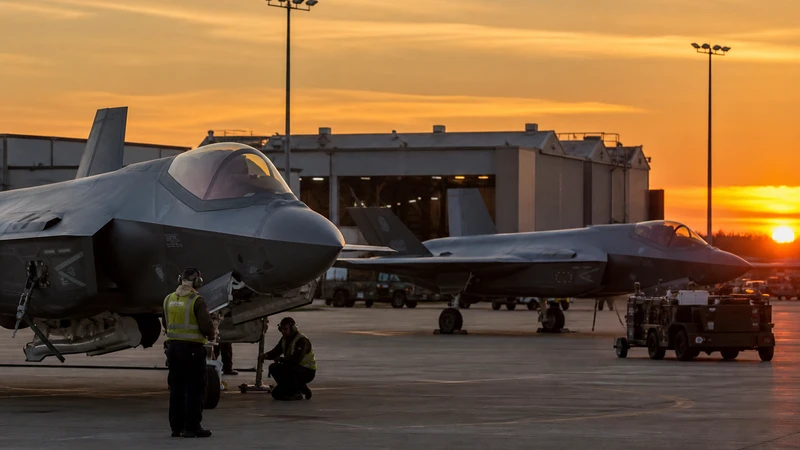
Readiness Is Becoming Washington’s Hardest Defense Test
There are moments in national life when the old budget arguments begin to sound strangely small. The United States is now living through one of them. Russia’s war in Ukraine has returned large-scale ground combat to Europe. China continues to expand and modernize its military, with particular attention to naval power, missiles, space and cyber capabilities. Iran and its proxies have kept pressure on U.S. forces and partners across the Middle East. North Korea remains a nuclear-armed missile state that tests both weapons and nerves.
Against that backdrop, the central question for American defense policy is not whether the world is dangerous. It plainly is. The question is whether the United States is preparing for that world with the seriousness it requires.
Military readiness and defense modernization are often treated as separate issues. Readiness is the practical matter of whether ships can sail, aircraft can fly, units can deploy, munitions are available and troops are trained. Modernization is the future-facing work of buying new bombers, submarines, missiles, satellites, sensors, drones and cyber tools. But in practice the two are bound together. A military that is ready today but technologically stagnant may deter for a season and fail later. A military that is modern on paper but short on spare parts, sailors, pilots and ammunition is a promise rather than a force.
A Force Pulled in Several Directions
The Pentagon is being asked to do many things at once. It must sustain a global presence, reassure allies, deter China in the Indo-Pacific, support NATO, protect shipping lanes, counter terrorism, defend U.S. bases, and prepare for warfare in space and cyberspace. Each of those missions has a logic. Together, they create strain.
The war in Ukraine has provided one harsh lesson: modern war consumes weapons at a rate that peacetime planning often underestimates. Artillery shells, air defenses, precision missiles, drones and spare parts are not abstractions in a think tank report. They are the difference between holding ground and losing it. U.S. assistance to Ukraine, along with support for Israel and operations connected to Middle East instability, has sharpened the debate over the defense industrial base. America can still produce extraordinary weapons. The harder question is whether it can produce them quickly, repeatedly and at scale.
This is where the country’s strategic challenge starts to resemble a moral one. We have often wanted deterrence on the cheap, imagining that a small number of exquisite systems can substitute for depth, redundancy and industrial capacity. But history is not kind to nations that confuse efficiency with resilience. A just peace, like a sturdy bridge, requires more than elegant design. It requires steel.
Modernization Cannot Be a Slogan
The United States is pursuing major modernization programs across the force. The B-21 Raider bomber is intended to strengthen long-range strike capability. The Columbia-class submarine is central to the future of the nuclear deterrent. The Navy continues to require more capable ships and submarines for a Pacific theater where distance and logistics matter enormously. The Air Force is trying to balance current fighter needs with future air dominance. The Army is investing in long-range fires, air defense and networked command systems. The Space Force, still young as a service, is responsible for domains that are increasingly central to both civilian life and military operations.
Yet modernization is not magic. Several major programs have faced delays, cost growth or technical complications. The Navy’s shipbuilding challenges are especially important because any serious Indo-Pacific strategy depends on maritime power. Submarines, in particular, are among America’s clearest advantages, but building and maintaining them requires a skilled workforce, stable suppliers and years of disciplined investment. These are not problems that can be solved by a patriotic press release.
Nor can artificial intelligence, drones and cyber capabilities be treated as glittering add-ons to an otherwise aging force. The wars of the future will likely be decided by networks as much as platforms, by software as much as steel, by the ability to find and strike faster than the enemy can hide and adapt. Still, conservatives should resist the fashionable temptation to believe that technology abolishes the old rules. Geography still matters. Ammunition still matters. Human courage and competence still matter.
The Personnel Problem Is Strategic
Readiness is also about people. The services have faced recruiting difficulties in recent years, with the Army in particular missing recruiting goals earlier in the decade before reporting improvement. The causes are complicated: a strong civilian labor market, medical and educational eligibility issues, declining familiarity with military service, distrust of institutions, family concerns and cultural divides between the armed forces and much of civilian society.
Some conservatives reduce this problem to debates over “wokeness” in the military. There are fair questions to ask about whether the armed forces have at times absorbed the ideological fashions of the universities and human resources departments. The military’s purpose is not social therapy; it is national defense. But it would be foolish to pretend that culture-war explanations cover the whole field. A young American deciding whether to enlist is also asking about pay, housing, family stability, medical care, career prospects and whether the nation actually honors service beyond ceremonial applause.
A serious readiness agenda would treat military families, maintenance crews, shipyard workers and junior officers as part of the same strategic ecosystem. It would recognize that a destroyer unavailable for maintenance reasons is not only a mechanical failure but an institutional one. It would ask whether the country has enough welders, engineers, machinists and logisticians, not only enough generals and admirals.
What Congress Should Demand
Congress has a constitutional role here that goes beyond writing checks. It should insist on clearer priorities, more honest cost estimates and tougher accountability for programs that fall behind. Defense spending should rise when threats rise, but conservatives should not confuse support for the military with indulgence toward bureaucracy. Waste in defense is not merely a taxpayer problem. It is a readiness problem.
Lawmakers should focus on several practical aims. First, rebuild munitions stockpiles and expand production capacity for weapons most likely to be needed in a major conflict. Second, stabilize shipbuilding and maintenance pipelines, especially for submarines and surface combatants. Third, strengthen air and missile defense, including protection for U.S. bases overseas. Fourth, accelerate fielding of unmanned systems and counter-drone defenses. Fifth, reduce regulatory and contracting barriers that make it unnecessarily difficult for innovative firms to work with the Pentagon.
Finally, the United States should push allies to carry more of the burden. This is not isolationism. It is alliance realism. NATO members have increased defense spending since Russia’s invasion of Ukraine, but Europe’s long-term security cannot rest indefinitely on American taxpayers and American logistics. In Asia, Japan, Australia, South Korea and the Philippines all matter in different ways to deterrence. American leadership is strongest when it calls partners upward, not when it quietly accepts dependency.
Peace Through Preparedness
The conservative case for military readiness is not a case for militarism. It is almost the opposite. A military that is visibly prepared, technologically capable and industrially backed is less likely to be tested. Weakness invites calculation. Confusion invites probing. Deterrence is the art of making aggression look unprofitable before the first shot is fired.
There is a deeper temptation in affluent societies to imagine that danger is an interruption of normal life, rather than one of the permanent facts with which statesmen must deal. This is the same error, in public policy form, as believing that the roof need not be repaired because the last storm passed. The wise household does not love storms. It simply remembers that they come.
America does not need panic. It needs sobriety. It needs a defense policy that links budgets to strategy, technology to manpower, allies to obligations and power to purpose. Readiness and modernization are not rival goods. They are the twin duties of a nation that still hopes to preserve peace in a world where peace is never self-enforcing.