
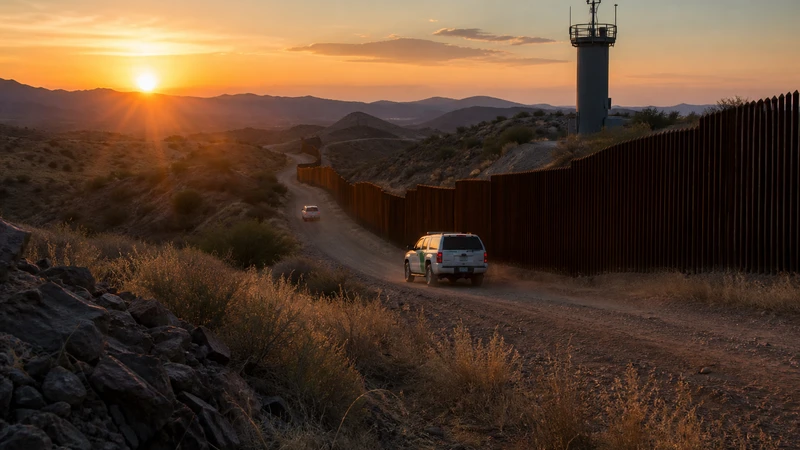
A Layered Border Strategy Is Back at the Center of the Debate
The argument over the southern border has too often been reduced to a symbol: the wall. To one side, it is the plain evidence that a country intends to defend its laws. To the other, it is a monument to fear and exclusion. But the border itself is not a symbol. It is nearly 2,000 miles of desert, river, ranchland, ports of entry, tribal land, federal property, private property, and urban crossings. It is also the place where political slogans meet physical reality.
That reality points to a simple conclusion: the United States needs physical barriers in some places, better technology in many places, and a legal immigration system that no longer rewards delay, evasion, and disorder. A wall by itself cannot secure the border. But neither can cameras, drones, or good intentions do the work of a barrier where a barrier is obviously useful.
This is where the current debate should begin. Border security is not an abstraction. It is an operational problem, and operational problems require tools fitted to terrain.
What Barriers Can Do — and What They Cannot
Physical barriers work best in areas where they slow illegal crossings long enough for Border Patrol agents to respond. That is not a theory so much as common sense. A fence does not need to be impossible to climb to be useful. It needs to change the clock. If it turns a 30-second dash into a five-minute delay, it can make the difference between an agent arriving in time and arriving too late.
The Trump administration built or replaced roughly hundreds of miles of border barrier, with federal reporting showing that much of the construction replaced older or less effective fencing. The Biden administration halted most new wall construction early in its term, though later it allowed limited work in certain areas and continued to face the practical consequences of unfinished projects, gaps, and unused materials.
Critics are right about one thing: no serious person should pretend that a coast-to-coast wall is a complete answer. Some terrain makes construction difficult. Some land is privately owned. Some crossings happen through tunnels, vehicles, boats, or fraudulent documents. And a large share of narcotics seizures, especially fentanyl, occurs at official ports of entry, where smugglers attempt to hide drugs in vehicles or cargo.
But those facts do not make barriers useless. They make them one part of a system. We do not reject locks on doors because windows also exist. We do not refuse seat belts because they cannot prevent every accident. A border wall is not a sacrament. It is a tool. The question is where the tool fits.
Technology Is Essential, But Not Magical
The strongest border-security proposals now pair physical barriers with surveillance towers, ground sensors, mobile cameras, drones, license-plate readers, and better inspection technology at ports of entry. This is the right direction. Technology can help agents detect crossings in remote areas, track movement, identify smuggling routes, and concentrate manpower where it is actually needed.
Ports of entry deserve particular attention. If Congress wants to reduce the flow of fentanyl and other contraband, it should invest in inspection equipment, canine teams, data systems, and staffing at legal crossings. Barriers between ports can reduce unlawful foot traffic, but the official crossings are where much of the commercial and passenger traffic moves — and where smugglers exploit volume and speed.
Still, technology has limits. Cameras do not arrest anyone. Sensors do not testify in immigration court. Drones cannot replace agents on the ground. A high-tech border without enough personnel is like a hospital full of monitors and too few nurses: it may know something is wrong, but it cannot always respond in time.
That is why manpower remains central. Border Patrol agents need reliable infrastructure, access roads, communications systems, and detention capacity that matches the law Congress has written. Without those things, technology can become a very expensive way to watch failure happen in real time.
The Asylum System Is Part of Border Security
No border-security plan can work if the legal incentives point in the opposite direction. In recent years, the asylum system has been overwhelmed by the number of people arriving at the border and seeking release into the United States while their cases proceed. Many claims are real. Many migrants are fleeing violence, poverty, failed governments, or cartel pressure. A decent country should not be indifferent to that suffering.
But compassion cannot mean the suspension of law. When asylum backlogs stretch for years, and when migrants believe that reaching U.S. soil is likely to mean release into the interior, the system invites more dangerous journeys and enriches criminal smuggling networks. The result is not mercy. It is managed chaos, with the vulnerable paying the highest price.
A serious policy would add immigration judges, speed up credible-fear screenings, remove those without valid claims more quickly, and preserve protection for those who truly qualify under U.S. law. It would also make legal immigration more orderly and transparent, so that the law-abiding applicant is not treated as a fool while the border-crosser is treated as a political problem to be postponed.
Conservative Policy Should Be Practical, Not Theatrical
For conservatives, the case for border security begins with sovereignty but should not end there. A nation has the right to decide who enters, under what conditions, and through what process. That is not cruelty. It is one of the basic duties of government. If the state cannot maintain a lawful border, it teaches citizens and migrants alike that law is negotiable.
At the same time, conservatives should resist the temptation to treat the border as a stage for permanent outrage. There are real trade-offs: property rights, environmental review, local community concerns, treaty obligations, and the cost of federal procurement. A party that believes in limited government should care whether contracts are effective, whether technology works as advertised, and whether money is being spent because it solves a problem rather than because it sounds tough in a speech.
The better approach is layered and measurable:
- Build or reinforce barriers where Border Patrol data and local commanders show they will reduce unlawful crossings.
- Expand surveillance technology in remote areas where agents need earlier detection and better tracking.
- Modernize ports of entry to target fentanyl, human trafficking, and fraudulent documents.
- Increase staffing and infrastructure so detection leads to timely response.
- Reform asylum processing so valid claims are heard quickly and invalid claims do not become a backdoor immigration system.
A Border That Reflects Law and Human Dignity
There is a moral dimension here that our politics often obscures. An unsecured border is not generous; it is an invitation to disorder. It empowers cartels, strains cities and states, and leaves migrants exposed to exploitation. But a secure border should not be an excuse for contempt. The people arriving at the border are human beings, not merely statistics in a federal spreadsheet or props in a campaign ad.
The old wisdom is that law and mercy are enemies. In fact, they need each other. Mercy without law becomes sentimentality, easily manipulated and finally exhausted. Law without mercy becomes cold and brittle. A functioning border policy requires both: firm rules, predictable enforcement, and humane treatment for those caught inside the machinery of migration.
The wall-versus-no-wall argument has lasted so long because it is politically useful. But the country needs something more adult than a slogan. It needs barriers where barriers work, technology where technology helps, agents who are not set up to fail, and courts that can decide cases before the facts on the ground become irreversible.
A sovereign country should be able to say yes to legal immigrants, yes to genuine refugees, and no to unlawful entry. That is not an extreme position. It is the minimum requirement for a government that still believes its laws mean what they say.
