
Churches Shoulder Strain at the Border
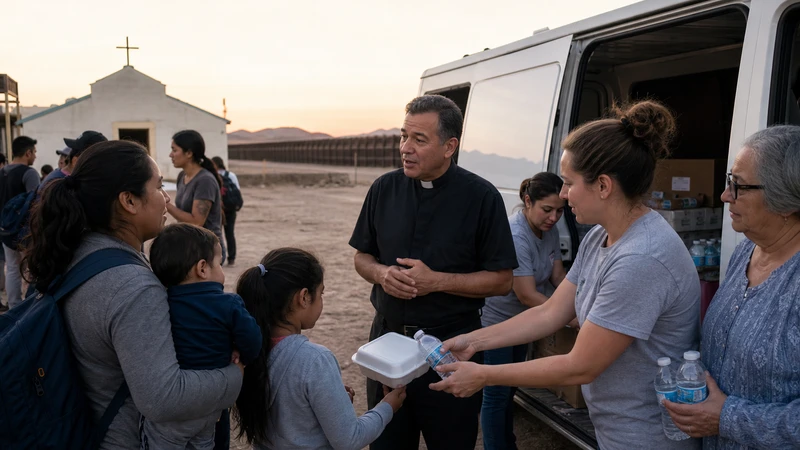
In border communities from Texas to Arizona and California, the first face many migrants meet after federal processing is not a government official but a church volunteer holding a bottle of water, a sandwich, or a list of bus schedules.
That small fact says a great deal about the immigration debate we are actually having, as opposed to the one shouted across cable-news panels. The border is not only a line on a map or a symbol in a campaign ad. It is a set of towns, parishes, shelters, clinics and bus stations where national failures become local burdens. And in many of those places, faith-based charities have become the shock absorbers of a system that neither party has managed to repair.
Catholic Charities agencies, Protestant churches, evangelical ministries, the Salvation Army, local synagogues and independent humanitarian groups have long served migrants after they are released by federal authorities or arrive in border communities needing short-term help. Their work is usually practical rather than ideological: meals, showers, clean clothes, diapers, basic medical referrals, help contacting relatives and assistance understanding travel arrangements. In some cities, churches open fellowship halls for overnight stays. In others, volunteers meet buses and direct people away from sleeping on sidewalks or wandering unfamiliar streets.
It is not glamorous work. It is the kind of work that rarely fits anyone’s preferred narrative.
Civil society where government falls short
Conservatives should be especially attentive to this story because it reveals something our tradition has often understood better than modern bureaucracy does: not every human problem is best handled first by Washington. Families, churches, local associations and private charities are not decorative extras in a healthy republic. They are part of its structure.
This is the old principle of subsidiarity, though one need not use the Catholic word for it. The idea is simple enough. Human needs should be addressed as close to the person as possible, by institutions that can see faces rather than case numbers. A church volunteer who knows the local bus station, the nearest clinic and the pastor down the road can often respond faster and more humanely than a distant agency.
But subsidiarity is not an excuse for federal abdication. That is the important distinction. Charity can offer a meal; it cannot set asylum law. A parish can provide blankets; it cannot run a coherent border-security strategy. A nonprofit can help a mother find her next bus; it cannot decide who has a valid legal claim to remain in the United States.
When churches are asked to cover the gaps created by confused policy, they are not replacing government. They are preventing disorder from becoming cruelty.
The political suspicion around mercy
The presence of religious charities at the border has also drawn political suspicion. Some critics argue that humanitarian groups, by helping migrants after release, encourage more migration or indirectly assist illegal entry. State and local officials have sometimes scrutinized nonprofit groups over whether their services cross legal lines. In 2024, for example, Texas officials moved against Annunciation House, a long-running Catholic shelter network in El Paso, accusing it of improper activity; the organization denied wrongdoing and defended its work as religiously grounded humanitarian service. The dispute became a national flashpoint over where compassion ends and immigration enforcement begins.
That question deserves serious treatment, not slogans. A country has the right and duty to control its borders. It is not immoral to enforce immigration law. Indeed, a nation that cannot reliably decide who enters, who stays and under what conditions will eventually lose the public trust required for legal immigration itself.
At the same time, feeding the hungry or sheltering a family for a night is not the same thing as writing immigration policy. Christians, Jews and other religious believers have obligations to the stranger that do not disappear because Congress is dysfunctional. The Good Samaritan did not first ask whether the wounded man’s paperwork was in order. But neither did he establish a theory of national sovereignty on the road to Jericho.
The moral challenge is to hold both truths together: mercy toward the person in front of us, and order for the political community we share.
Federal money and local accountability
The role of government funding complicates the picture. Faith-based and secular nonprofits have received support through federal programs such as the Shelter and Services Program, administered by the Federal Emergency Management Agency, which helps local governments and organizations cover costs related to migrants released from Department of Homeland Security custody. These grants can pay for temporary shelter, food, transportation and related services.
There is nothing inherently improper about government partnering with private charities for limited public purposes. The United States has done this in many fields, including disaster relief, refugee resettlement, addiction recovery and homelessness services. Faith-based organizations often have networks, facilities and volunteers already in place, which means they can move quickly when a crisis arrives.
Still, public money requires public accountability. Taxpayers have a right to know how funds are used, whether services are lawful, and whether programs are helping manage an emergency or quietly normalizing a broken system. Religious charities should welcome reasonable transparency, not because their motives are suspect, but because trust is one of their most valuable assets.
Conservatives, meanwhile, should resist the temptation to treat every church shelter as a political enemy. Some of these groups are not lobbying for open borders; they are cleaning up the human consequences of decisions made far above their pay grade. If Washington releases migrants into a city with little notice and no workable plan, someone will have to respond. Better that it be a church basement with volunteers than a sidewalk with no one in charge.
What border communities need
The policy implications are not mysterious. Border communities need predictable federal coordination, faster and fairer asylum adjudication, detention capacity appropriate to the law, consequences for fraudulent claims, and legal pathways that are clear enough to reduce incentives for chaos. They also need reimbursement systems that do not leave small towns and charities carrying national costs on local budgets.
But they need something else as well: a political culture capable of telling the truth. The truth is that the United States cannot admit everyone who wishes to come. The truth is also that many who arrive are vulnerable human beings, including families and children, and they must not be treated as props in a morality play. The truth is that compassion without order becomes sentimentality, while order without compassion becomes something colder than justice.
Faith-based charities at the border live daily in that tension. They remind us that policy is finally about persons, not abstractions. But they also remind us that private virtue cannot indefinitely compensate for public disorder.
A country blessed with strong churches and generous volunteers should be grateful for them. It should not exploit them. The better measure of our immigration system is not whether charitable people can keep patching its holes, but whether our leaders can build something orderly enough that charity returns to its proper role: not emergency substitute for the state, but witness to the dignity of the human person.
