
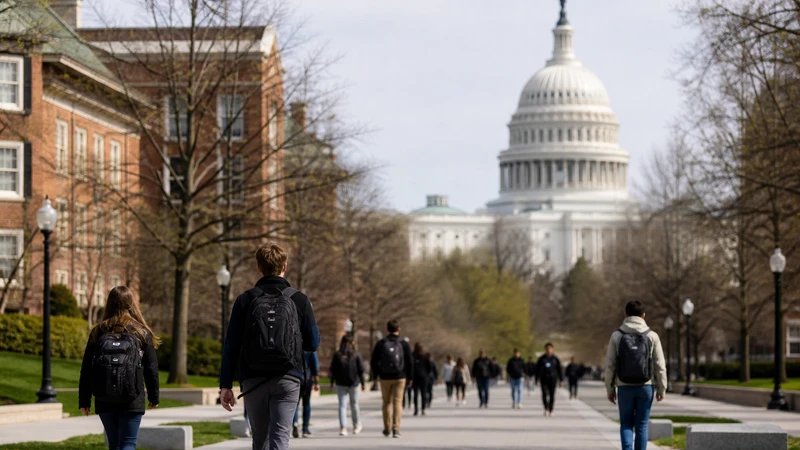
Washington Turns Its Attention to Campus Antisemitism
The American university has always been a place where young people try out strong ideas, sometimes foolish ones, under the shelter of free inquiry. But the recent crisis over antisemitism on college campuses has raised a harder question: when does a campus cease to be a forum for argument and become an institution that tolerates intimidation?
Since Hamas’s Oct. 7, 2023 attack on Israel and the war in Gaza that followed, many campuses have seen protests, encampments, student discipline disputes, civil rights complaints, and in some cases police intervention. The issue is not whether students may criticize Israel. They plainly may. The issue is whether Jewish students are being denied the equal access, safety, and ordinary dignity that federal law promises them.
That distinction matters because it is the hinge on which any serious policy response must turn. A government that tries to punish every ugly slogan will become a censor. A government that ignores threats, harassment, or exclusion because they are wrapped in political language will become an accomplice to disorder.
The Legal Framework: Title VI and Federal Funds
The main federal tool is Title VI of the Civil Rights Act of 1964, which bars discrimination based on race, color, or national origin in programs receiving federal money. For years, federal civil rights officials have treated antisemitic discrimination as potentially covered when it targets Jews based on shared ancestry or ethnic characteristics. That approach has been used by both Republican and Democratic administrations.
In 2019, President Donald Trump signed an executive order directing federal agencies to consider the International Holocaust Remembrance Alliance’s working definition of antisemitism, while also noting that agencies must respect First Amendment protections. In 2023, the Biden administration released a national strategy to counter antisemitism, calling for better campus reporting, security coordination, education, and enforcement of civil rights law.
The Department of Education’s Office for Civil Rights has opened investigations into a number of colleges and school systems following complaints involving antisemitism and related discrimination. An investigation is not a finding of guilt. But the volume of complaints has made clear that the problem is not imaginary, and that universities can no longer treat it as merely a public relations inconvenience.
Congressional Pressure and University Governance
Congress has also pushed the issue into the center of national politics. House hearings in late 2023 became a turning point after university presidents struggled to answer questions about whether calls for genocide against Jews would violate campus conduct rules. The fallout was severe: University of Pennsylvania President Liz Magill resigned in December 2023, and Harvard President Claudine Gay resigned in January 2024 amid several controversies, including criticism of her congressional testimony and questions about plagiarism.
Those hearings were not a model of calm deliberation in every respect. Congressional theater is still theater. Yet the central question was legitimate. Elite universities have spent years building elaborate systems to police bias, microaggressions, hostile environments, and identity-based harm. When Jewish students asked whether those systems applied to them, too many administrators seemed suddenly to rediscover the virtues of procedural caution.
Conservatives have noticed the inconsistency for obvious reasons. Many universities have been willing to regulate speech in the name of emotional safety when the protected group fits the campus’s preferred moral narrative. But when antisemitism appears under the banner of anti-colonial politics or anti-Zionism, the institutional reflex often changes. The rule book grows more complicated. The administrators grow more philosophical. The victim is asked to appreciate the context.
Free Speech Is Not a Loophole for Harassment
The answer, however, is not to replace one double standard with another. Public universities are bound by the First Amendment, and private universities often promise robust expressive freedom in their own policies. Students must remain free to argue about Israel, Zionism, Palestinian statehood, American foreign policy, and the conduct of war. Some of that argument will be harsh, and in a free country harsh speech is not automatically unlawful speech.
But there is a line between protest and coercion. Blocking Jewish students from entering a classroom, threatening them because they wear a Star of David, vandalizing Jewish institutions, or creating conditions in which Jewish students cannot participate in campus life is not merely speech. It is conduct. Universities already know how to discipline conduct when they choose to do so.
The best policy response should therefore be clear, limited, and evenhanded:
- Enforce existing civil rights law. The Department of Education should investigate credible complaints promptly and publish clear findings when investigations conclude.
- Condition federal funds on compliance, not ideology. Universities receiving taxpayer support must show that they protect students from unlawful discrimination, including antisemitic harassment.
- Protect due process. Accused students and faculty should receive fair procedures. Panic is not a substitute for justice.
- Defend viewpoint neutrality. Rules should apply to antisemitism, anti-Muslim harassment, anti-Christian bigotry, and other identity-based threats with the same seriousness.
- Separate speech from disruption. Administrators should not punish mere dissent, but they should not permit encampments or demonstrations to seize buildings, shut down classes, or exclude students.
Why Conservatives Should Care About Institutional Order
There is a temptation on the right to see the university’s current embarrassment as poetic justice. After all, many of these institutions taught a generation that speech can be violence, that identity confers moral authority, and that bureaucratic supervision can cure prejudice. Now they find those doctrines turned inward, and they do not like the result.
But conservatives should resist the easy pleasure of watching institutions burn. The deeper conservative concern is not revenge but order. Universities form judges, journalists, teachers, diplomats, doctors, ministers, and business leaders. When they cannot distinguish between moral argument and mob pressure, the damage does not stay on campus. It travels outward into the republic.
There is also a moral reality here that politics can obscure. Antisemitism is not just another prejudice. It is one of the oldest and most adaptable hatreds in Western history, capable of dressing itself in religious, racial, nationalist, and revolutionary costumes. In one age it accuses Jews of being rootless cosmopolitans; in another, of being tribal nationalists. Its consistency lies not in logic but in obsession.
Christians, especially, should be clear-eyed about this. The Jewish people are not an abstraction in someone else’s political argument. They are the people through whom the Scriptures came to the world, the people of Abraham, Moses, David, Mary, and the apostles. That theological fact does not settle every policy dispute in the Middle East. But it should make casual indifference to Jewish fear impossible.
A Serious Federal Response Requires Restraint
Washington has a role to play, but it must play that role carefully. A national speech code would be unconstitutional at public universities and unwise everywhere. Yet a laissez-faire approach that tells Jewish students to endure threats as the price of intellectual life is equally unacceptable.
The right balance is not mysterious. Enforce the law. Demand institutional competence. Protect free speech. Punish violence, threats, and targeted harassment. Require universities to live by the standards they already claim to honor.
The campus antisemitism crisis has revealed something larger than a failure of security. It has exposed a failure of moral confidence among institutions that once saw themselves as guardians of civilization. The remedy will not come from Washington alone. But federal policy can at least insist on this modest, necessary principle: a university that takes public money may not become a place where Jewish students are treated as strangers in their own country.