
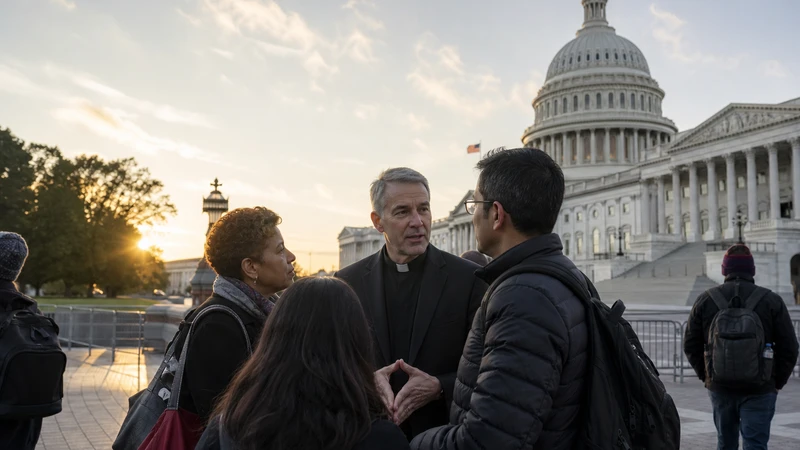
America’s Old Church-State Argument Has Returned
There is a familiar American argument that never quite ends, because it concerns something deeper than law. It is the argument over whether faith belongs in public life, and what happens when government either welcomes it too eagerly or pushes it away too aggressively.
In recent years, that argument has appeared in disputes over prayer at public events, religious schools and public funding, conscience protections for religious employers, faith-based charities, religious speech by public employees, and the place of moral conviction in politics. The details differ. The deeper question is the same: Can a country with a secular Constitution remain hospitable to religion without making the state religious?
The conservative answer should be yes. But it requires a distinction that our political culture often blurs. Religion belongs in the public square. It does not belong as a possession of the state.
The First Amendment Was Not Built for Secularism Alone
The First Amendment contains two commands that are sometimes treated as enemies: Congress shall make no law respecting an establishment of religion, or prohibiting the free exercise thereof. In plain terms, the federal government may not create an official church, and it may not punish citizens for living out their faith.
For much of the 20th century, American church-state law was shaped by anxiety about establishment. Courts often treated religious expression in public settings as something suspect, especially in schools. That reflected real concerns in a country with religious minorities and nonbelievers. Government-led religious pressure can be coercive even when it is polite. A child in a classroom, a student before a coach, or a small-town citizen before a city council may feel the weight of official approval and disapproval very keenly.
But the legal climate has shifted. In cases including Trinity Lutheran, Espinoza, and Carson, the Supreme Court held that states may not exclude religious institutions from generally available public benefit programs simply because they are religious. In Kennedy v. Bremerton School District, the Court sided with a public school football coach who prayed at midfield after games, emphasizing that private religious expression does not automatically become government speech because it occurs in public view.
One need not agree with every line of the Court’s reasoning to see the larger point. A government that treats religion as uniquely disqualifying is not neutral. It is making a judgment of its own, and not a very liberal one.
Neutrality Does Not Mean Naked Public Life
The word neutrality does a great deal of work in church-state debates, often more than it can bear. Some Americans use it to mean that government should neither favor nor punish religion. Others use it to mean that religious arguments should be kept outside public decision-making altogether.
The first meaning is a constitutional principle. The second is a secular creed pretending not to be one.
Religious citizens do not enter politics as disembodied policy machines. They bring moral assumptions with them, just as secular progressives, libertarians, nationalists, environmentalists, and human-rights activists do. A Catholic who argues that unborn life deserves legal protection is not smuggling theology into politics any more than a secular liberal who argues for universal human dignity is smuggling Kant into the zoning board. Both are making moral claims. Both must give reasons their fellow citizens can weigh. But neither should be told that conviction becomes illegitimate the moment it is religiously informed.
This point matters for conservatives because many of the country’s most serious policy debates are moral before they are technical. Questions about parental rights, abortion, religious schools, medical conscience protections, assisted suicide, gender policy, poverty, immigration, and family formation cannot be answered by data alone. Data can discipline our arguments. It cannot tell us what a human being is for.
A politics that pretends otherwise does not become more rational. It merely hides its theology.
The Temptation of Christian Power
Still, religious conservatives should not mistake recent legal victories for a license to sacralize politics. There is a kind of church-state confusion that comes not from secular judges but from believers themselves, especially when they begin to imagine that Christianity needs government power to be credible.
This is the temptation behind the cruder forms of Christian nationalism. The problem is not that Christians love their country or want its laws to reflect moral truth. Every political movement seeks laws that reflect its moral vision. The problem begins when Christianity is treated less as a demanding faith than as a civilizational brand, a way of saying who really owns America.
That move is both politically unwise and theologically dangerous. Politically, it alienates many citizens who might otherwise be open to religious arguments made with humility and reason. Theologically, it makes the church look like a chaplaincy for a party, a tribe, or a strongman. Christianity has survived empires. It does not need to be reduced to campaign merchandise.
The old conservative insight is that institutions matter because human beings are fallen. That insight applies to churches as much as to legislatures. When religion grasps too tightly at state power, it often gains influence at the price of credibility. When the state tries to manage religion, it usually damages both liberty and faith.
What Policy Should Aim For
A wiser approach to church-state relations would begin with several principles.
- Equal access: Religious groups should be eligible for generally available public programs on the same terms as secular groups, provided they meet neutral rules.
- No coercion: Government officials should not pressure citizens, especially students or employees, to participate in religious acts.
- Conscience protection: In areas such as health care, education, and employment, the law should make reasonable room for religious conviction where doing so does not impose grave harm on others.
- Civic humility: Public officials should be free to speak about faith, but they should not imply that citizenship depends on religious identity.
- Pluralism with memory: America should acknowledge its religious inheritance without pretending that only one kind of believer, or only believers, count as fully American.
These principles will not settle every case. Hard cases exist because liberty is real. A school prayer dispute is not the same as a prison chaplaincy dispute. A public grant to repair a playground is not the same as direct funding for religious instruction. A private citizen praying silently is not the same as a mayor asking the town to bow its head under official authority.
But distinctions are the stuff of constitutional government. They are what keep us from turning every controversy into a culture-war referendum on whether God has been expelled from America or theocracy has arrived at the school board.
Faith Needs Freedom More Than Favor
The American settlement is fragile because it asks something difficult of both believers and skeptics. It asks secular citizens to accept that religion is not merely a private hobby, like gardening or chess, but a public source of meaning and moral obligation. And it asks religious citizens to accept that truth does not require state sponsorship to remain true.
This is not a compromise born of indifference. It is a recognition of what faith is. Belief compelled by law is not belief in the full sense. It is compliance. And a public square scrubbed clean of religious speech is not neutral in the full sense. It is a monument to a rival orthodoxy.
America does not need an established church. It does need citizens and leaders who understand that religious liberty is not a concession granted to the backward. It is one of the conditions of a free society. The soul must be free not because faith is unimportant, but because it is too important to be handed over to the state.