
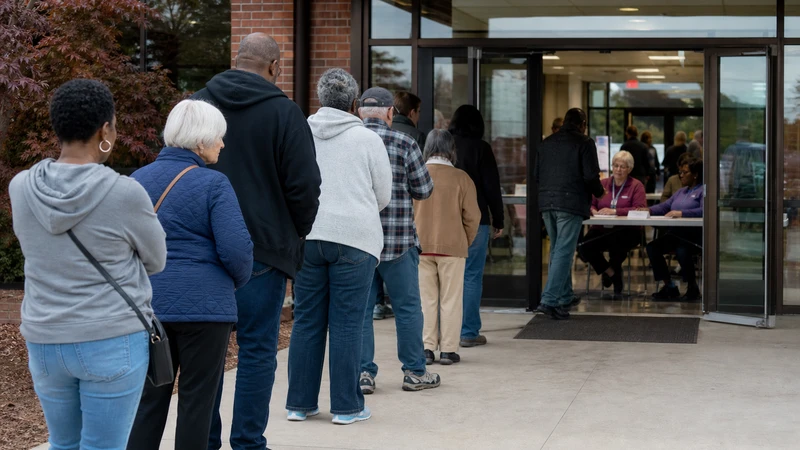
Voter ID Remains a Test of Election Trust
The argument over voter identification laws has a way of returning, like a hymn everyone knows but no one sings the same way twice. Supporters describe photo ID requirements as a simple safeguard, the kind of ordinary precaution Americans accept when boarding a plane, buying certain medicines, or entering many government buildings. Critics answer that voting is not a consumer transaction but a constitutional right, and that even small burdens can matter for elderly citizens, low-income voters, students, and people who move frequently.
Both claims contain some truth. That is what makes the issue politically durable and morally serious. Election law is not just about catching fraud after it occurs. It is also about convincing citizens, before and after an election, that the rules are stable, fair, and worthy of confidence. A republic cannot run for long on suspicion alone. But neither can it ask voters to trust a system that treats basic verification as somehow shameful.
The Legal and Policy Landscape
Voter ID laws vary widely across the country. Some states require a government-issued photo ID at the polls. Others accept non-photo documents such as utility bills, bank statements, or government correspondence. Some states allow voters without required identification to cast provisional ballots and later verify their identity. A number of states conduct elections largely by mail and rely on signature verification, ballot tracking, voter registration checks, and other safeguards rather than in-person photo identification.
The Supreme Court has permitted voter ID requirements in principle. In Crawford v. Marion County Election Board in 2008, the Court upheld Indiana’s photo ID law against a facial challenge, concluding that the state’s interests in deterring fraud and promoting public confidence were legitimate. That decision did not bless every possible identification rule. It did, however, establish that voter ID is not inherently unconstitutional merely because it imposes some administrative burden.
Federal law also already recognizes identification as part of election administration. The Help America Vote Act of 2002 requires certain first-time voters who registered by mail to provide identification before voting, though it gives states flexibility in implementation. In other words, the basic idea that voters should be able to establish that they are who they claim to be is not some radical innovation. The real dispute concerns how strict the requirement should be, what forms of ID should count, and how states should handle voters who arrive without the required documents.
Why Conservatives Keep Returning to the Issue
For conservatives, the case for voter ID begins with a fairly modest proposition: rules that govern elections should be clear, neutral, and enforceable before the votes are cast. The point is not that fraud is everywhere, or that every close election is suspect. Responsible conservatives should resist that temptation. A political movement that sees conspiracy in every defeat eventually loses the discipline required for self-government.
But it is equally unwise to pretend that election integrity is a symbolic concern invented by partisans. Voter rolls must be maintained. Absentee ballots must be handled securely. Chain-of-custody procedures matter. Signature verification standards should not be vague or improvised. Poll workers need training. Counting processes should be observable within reasonable limits. Identification rules fit within this larger architecture of trust.
The conservative instinct here is institutional rather than merely partisan. A bank does not ask for identification because it believes every customer is a thief. It asks because trust is strengthened by procedures that do not depend on personal virtue alone. Elections deserve at least that level of seriousness.
The Access Objection Should Be Taken Seriously
Still, a voter ID law can be defensible in theory and poorly designed in practice. If a state requires a narrow form of identification but makes it difficult to obtain, especially in rural areas or for citizens without reliable transportation, it has created a problem it should not dismiss. If offices that issue IDs have limited hours, if underlying documents are costly or hard to replace, or if name discrepancies create unnecessary obstacles, the burden may fall most heavily on citizens least able to navigate bureaucracy.
Conservatives should be especially alert to this danger because bureaucracy is not suddenly benign when it serves a policy we like. The same government that can make licensing, permitting, and benefits difficult can also make voting paperwork needlessly complicated. The answer is not to abandon identification. It is to pair it with practical accommodations that make compliance realistic.
That means free voter IDs. It means broad access to issuing offices, including mobile units where necessary. It means accepting a reasonable range of documents. It means provisional ballots with a clear cure process. It means public education well before Election Day. A law designed to secure elections should not look like a trap for the unwary.
Beyond the Polling Place
The voter ID debate also tends to narrow our attention too much. In modern elections, the polling place is only one part of the system. Mail voting, early voting, same-day registration, automatic registration, ballot harvesting rules, drop box security, voter list maintenance, and post-election audits all shape public confidence.
A serious election security agenda would treat these elements together. It would not insist that photo ID at the precinct solves every problem, nor would it declare that any safeguard is a disguised attack on democracy. States should have room to experiment, but the public should expect certain basics: accurate voter rolls, transparent counting, bipartisan observation, secure ballot storage, reliable audits, and timely reporting of results.
Here the religious analogy is almost unavoidable, though politics is a poor substitute for faith. Trust is not created by saying “trust us” more loudly. It is built through habits, visible forms, repeated assurances that are not merely verbal. Institutions, like churches or families, depend on rituals that teach people what is being protected. Election procedures are civic rituals. When they are careless, opaque, or constantly changing, citizens naturally wonder what else is unstable.
A Better Path for Election Reform
The best conservative approach to voter ID and election security is therefore neither maximalist nor apologetic. It should say plainly that identification is a normal part of administering a serious election. It should also say plainly that every eligible citizen should be able to meet the requirement without unreasonable cost, confusion, or delay.
That position will not satisfy the loudest voices on either side. Some activists treat any ID requirement as voter suppression by another name. Some populists speak as though identification alone can redeem every election disappointment. But democratic legitimacy lives in the space between those slogans. It requires rules strong enough to prevent abuse and accessible enough to command consent.
America’s election fights are often described as technical disputes, but beneath them lies a deeper question: Do we still believe we are capable of governing ourselves under rules we did not design solely for our own side? Voter ID laws, properly written, can be part of an answer. They can remind citizens that voting is both a right and a public act, both personal and communal, both an expression of liberty and a contribution to the common good.
The task is to secure the ballot without surrounding it with needless suspicion, and to widen access without dissolving standards. That is not a contradiction. It is the ordinary work of republican government, which asks us to hold two truths together: the vote is precious, and precious things are worth guarding well.