
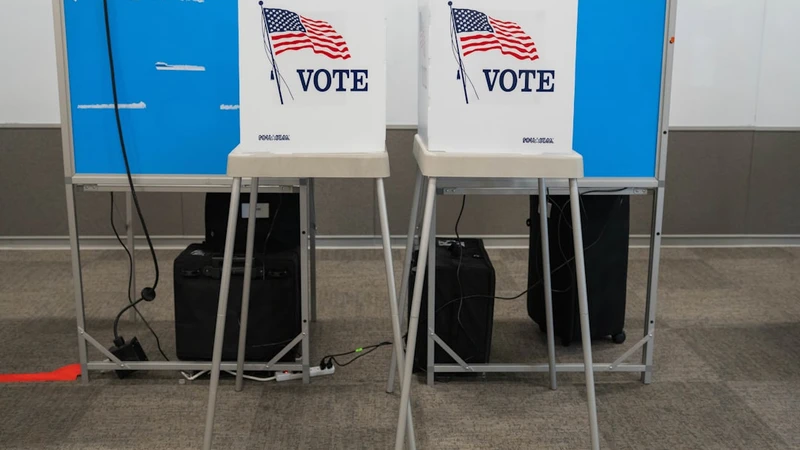
Voter ID Returns to the Center of the Election Security Debate
As the country moves toward another national election cycle, the argument over voter identification has returned to a familiar place: everyone says they want secure elections, but Americans disagree sharply about what security requires.
For conservatives, voter ID laws are usually described as a common-sense guardrail, the electoral equivalent of a lock on the front door. For many Democrats and voting-rights advocates, they are often treated as a burden that can fall hardest on poor voters, elderly voters, students, and racial minorities. The result is a debate in which both sides often talk past each other, because they begin from different fears. One side fears fraud and disorder. The other fears exclusion.
The better question is not whether either fear is imaginary. It is how a serious republic should answer both at once.
What Voter ID Laws Actually Do
Voter ID laws vary widely by state. Some states require a government-issued photo identification before a voter may cast a regular ballot in person. Others accept non-photo documents, such as a utility bill, bank statement, paycheck, or government document showing the voter’s name and address. Some states allow voters without ID to cast a provisional ballot and later confirm their identity. Others permit an affidavit or another voter’s attestation.
This variation matters. The phrase “voter ID” sounds like one policy, but in practice it describes a family of policies. A strict photo ID rule with few alternatives is very different from a system that accepts multiple forms of identification and provides free IDs to eligible citizens who need them.
The legal backdrop is also important. In 2008, the U.S. Supreme Court upheld Indiana’s photo ID law in Crawford v. Marion County Election Board, finding that the state’s interests in preventing fraud and promoting confidence in elections could justify the requirement. That decision did not make every voter ID law automatically valid, but it did establish that voter identification is not, by itself, unconstitutional.
Federal law already recognizes some identification needs. Under the Help America Vote Act of 2002, certain first-time voters who register by mail must provide identification before voting, unless they have already met verification requirements. In other words, the idea that identity matters at the ballot box is not some exotic conservative invention. It is already part of the election system.
Election Security Is Bigger Than Photo ID
Still, voter ID is only one piece of election security. A state could require photo identification at the polling place and still run sloppy elections if its voter rolls are poorly maintained, its ballot custody rules are weak, or its post-election audits are inadequate.
A serious election security framework includes several safeguards:
- Accurate voter rolls: States must keep registration lists current while following federal protections that prevent improper removal of eligible voters.
- Paper ballot records: Voter-verifiable paper ballots or paper trails help ensure that electronic systems can be checked.
- Risk-limiting or post-election audits: Audits can confirm whether reported outcomes match the paper record.
- Clear chain-of-custody rules: Ballots should be tracked from the moment they are cast or received until counting is complete.
- Transparent counting procedures: Observers from both major parties should have meaningful access without being allowed to disrupt the process.
- Secure mail voting rules: Signature verification, ballot tracking, deadlines, and cure procedures should be clear before Election Day.
In-person voter ID may help prevent one kind of abuse: someone appearing at the polls under another person’s name. But many modern election disputes involve mail ballots, registration errors, ballot harvesting rules, late-arriving ballots, or public confusion about counting. Treating photo ID as the whole answer is like treating a deadbolt as the whole of home security. It helps. It is not everything.
The Conservative Case for ID — and for Access
The conservative case for voter ID is strongest when it is tied to civic trust rather than partisan advantage. Elections are not merely administrative exercises. They are rituals of self-government. If citizens believe the rules are loose, arbitrary, or easy to manipulate, they will lose confidence in the result even when the result is accurate.
That confidence is not a luxury. In a large, diverse republic, losing is tolerable only when the loser believes the contest was fair. The peaceful transfer of power depends not on sentimental slogans but on the ordinary citizen’s trust that the votes were lawfully cast and honestly counted.
But conservatives should also be clear about the other half of the bargain. If the state requires identification to vote, the state should make lawful identification easy to obtain. That means free IDs for voting purposes, reasonable office hours, mobile ID services where necessary, and clear public information about what documents are accepted. A right should not depend on whether someone can take a day off work, drive across a rural county, or navigate a confusing bureaucracy.
This is not a concession to the left. It is an institutional conservative principle. The state should not create needless friction between the citizen and the ballot. Fraud prevention and voter access are not enemies unless politicians make them enemies.
Why the Debate Has Become So Bitter
Part of the bitterness comes from the fact that election rules are now filtered through party interest. Republicans tend to support voter ID because their voters are more likely to worry about fraud. Democrats tend to oppose stricter ID laws because their coalition includes more voters who may face practical barriers to documentation. Each side sees its own position as democratic and the other side’s position as cynical.
There is some cynicism in the debate, but there is also genuine concern. It is foolish to dismiss every election-security proposal as “voter suppression.” It is also foolish to pretend every restriction is automatically justified by invoking “integrity.” The word integrity should not become a magic stamp that makes any rule wise.
A mature politics would ask concrete questions. What forms of ID are accepted? Is a free ID available? How easy is it to get? Are provisional ballots counted when identity is confirmed? Are poll workers trained consistently? Are rules announced well before the election rather than changed late in the process? These details decide whether a law is a safeguard or a stumbling block.
A Sensible Path Forward
The best model for election policy is not maximum looseness or maximum suspicion. It is reliable verification with generous access. Require voters to prove they are who they say they are. Then make that proof as simple and fair as possible for every eligible citizen.
States considering voter ID laws should pair them with practical access measures: free identification, broad document options where appropriate, provisional ballots with clear cure procedures, and public education campaigns that begin months before voting starts. States should also strengthen the less glamorous parts of election administration: clean rolls, paper records, bipartisan oversight, secure ballot handling, and transparent audits.
In a healthier political culture, this would not be difficult. We prove our identity to board an airplane, open a bank account, pick up certain prescriptions, and enter many government buildings. Voting is more sacred than these things, not less. But because it is sacred, the state must be careful not to turn the requirement into a maze.
The older language of republican government understood this balance better than we do. Citizenship involves both rights and duties. The right to vote is fundamental. The duty to protect the vote is also fundamental. A country that treats safeguards as oppression will invite distrust. A country that treats access as an afterthought will invite injustice.
Voter ID, properly designed, can be part of a sound election system. But it should be defended honestly: not as a cure-all, not as a partisan weapon, and not as a substitute for competent election administration. It is one lock on the door of democracy. The door should be secure. It should also be open to every citizen who has the right to walk through it.