
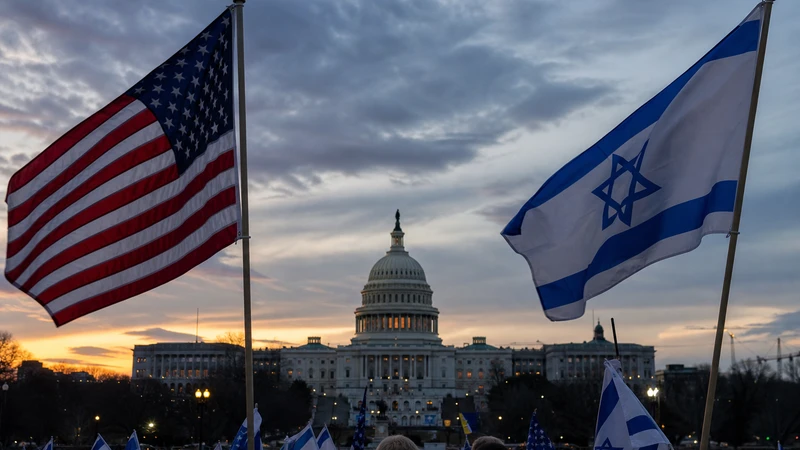
A Durable Consensus Under Strain
In a Washington culture that now seems able to turn even routine appropriations into trench warfare, one fact still deserves notice: support for the U.S.-Israel alliance remains one of the more durable bipartisan commitments in Congress.
That does not mean the consensus is serene. It is not. Since the Hamas attacks of Oct. 7, 2023, and Israel’s subsequent war in Gaza, arguments inside both parties have grown sharper. Progressive Democrats have pressed for stricter conditions on arms transfers and have criticized Israel’s conduct of the war. Some Republicans, especially those more skeptical of foreign aid in general, have questioned whether the United States can continue large overseas commitments while facing debt, border insecurity, and military readiness challenges at home.
Yet when Congress has been forced to move from rhetoric to votes, the broad shape of the alliance has held. In April 2024, the House approved a major Israel security supplemental by a wide bipartisan margin, and the Senate later passed the broader national security package that included assistance for Israel, Ukraine, and Indo-Pacific partners. President Biden signed it into law. The numbers mattered less than the message: even in an era of factional politics, Israel’s security still commands support across party lines.
What Congressional Support Actually Means
The phrase “support for Israel” can be used so often that it becomes a slogan rather than a policy. In Congress, however, it has several concrete meanings.
First, it means security assistance. Under a 2016 memorandum of understanding negotiated during the Obama administration, the United States committed to provide Israel with $38 billion in military assistance over 10 years, covering fiscal years 2019 through 2028. That includes foreign military financing and missile defense support. The agreement itself is revealing: it was not a Trump-era or Biden-era invention, but a long-term commitment made under a Democratic president and continued under Republican and Democratic administrations alike.
Second, it means cooperation on missile defense. Systems such as Iron Dome and David’s Sling have become familiar names to Americans who may know little about Israeli politics but understand the moral difference between defending civilians from rockets and deliberately targeting them. Congress has repeatedly funded U.S.-Israel missile defense cooperation, not merely as charity to an ally but as a practical investment in military technology and regional stability.
Third, it means diplomatic backing, though this is more contested and depends heavily on the administration in power. Congress often plays the role of reinforcing the alliance when executive branch policy becomes cautious or ambiguous. This has been true under presidents of both parties. Legislators tend to be more openly pro-Israel than diplomats, partly because they answer to voters, including Jewish communities, evangelical Christians, national security conservatives, and many Americans who see Israel as a fellow democracy in a dangerous region.
Why the Alliance Still Attracts Both Parties
The bipartisan case for Israel rests on three pillars: strategic interest, democratic solidarity, and historical memory.
The strategic argument is the simplest. Israel is a major non-NATO ally of the United States and one of America’s closest intelligence and military partners in the Middle East. It sits in a region where Iran arms proxies, terrorist groups operate across borders, and American interests are constantly tested. A secure Israel complicates the plans of Tehran, deters regional aggression, and gives the United States a capable partner that does not require American troops to defend it in the way many weaker allies might.
The democratic argument is less fashionable in some circles than it once was, but it remains important. Israel is an imperfect democracy, as all democracies are imperfect, and its politics can be as bitter and fractious as our own. But it has competitive elections, an independent judiciary, a free press, and a vigorous civil society. Those facts do not answer every question about Israeli policy, especially in wartime, but they do distinguish Israel from the authoritarian and theocratic forces arrayed against it.
The historical argument is the deepest. After the Holocaust, the existence of a Jewish state is not an abstraction. It is a civilizational fact with moral weight. Americans can debate borders, settlements, prime ministers, and military tactics. But a politics that forgets why Jewish security matters has lost contact with one of the central lessons of the 20th century.
The Gaza War Has Changed the Debate
Still, it would be foolish to pretend that nothing has changed. The Gaza war has exposed real divisions, especially among younger voters and on the Democratic left. Civilian suffering in Gaza has become a major political and moral issue. Campus protests, some peaceful and some marred by antisemitic rhetoric or intimidation, have pushed the conflict into American domestic politics in a way that is hard to contain.
Here conservatives should be careful. It is right to insist that Hamas bears responsibility for starting the war with mass murder and hostage-taking. It is right to defend Israel’s right to dismantle a terrorist organization embedded in civilian areas. But it is also right to say that moral seriousness does not end with identifying the aggressor. Civilian life matters because it is human life, not because it is politically convenient. Israel’s friends do it no favors by speaking as though wartime conduct is beyond scrutiny.
The better conservative position is not blank-check politics. It is alliance with accountability. Congress should support Israel’s qualitative military edge, replenish defensive systems, stand firmly against Hamas and Iran, and also demand clarity from any administration about objectives, endgames, humanitarian safeguards, and how U.S. weapons are being used. Oversight is not betrayal. In a republic, it is how serious alliances are maintained.
The Risk of Making Israel a Partisan Trophy
The greatest long-term danger may not be one particular vote. It is the temptation to turn Israel into a partisan trophy. Republicans sometimes speak as if they alone are Israel’s reliable friends. Democrats sometimes imply that support for Israel must be constantly re-earned through agreement with the latest progressive framework. Both instincts are dangerous.
If support for Israel becomes merely another red-blue identity marker, then the alliance will weaken over time. Foreign policy cannot survive for long as a culture-war accessory. A wise Congress should want support for Israel to remain broad, stable, and serious enough to survive changes in presidents, speakers, committee chairs, and public moods.
This means Republicans should welcome pro-Israel Democrats rather than treating them as political inconveniences. It also means Democrats should resist the voices in their coalition that slide from criticism of Israeli policy into hostility toward Jewish self-determination itself. There is a line between arguing over a government’s decisions and denying a people’s right to live securely in their ancestral homeland. That line must remain bright.
A Test of American Seriousness
The U.S.-Israel alliance is not based on sentiment alone, though sentiment plays a role. It is not based on theology alone, though many religious Americans understand Jewish history through a sacred lens. It is, at its best, a sober recognition that nations need friends, that democracies are not abundant in every region, and that evil does not become less evil because confronting it is complicated.
Congressional support for Israel has endured because it answers both interest and conscience. The task now is to keep it from becoming either an empty slogan or a partisan weapon. The alliance should be debated, funded, overseen, and defended with the seriousness it deserves.
In a time when American politics often rewards theatrical certainty, that kind of seriousness can feel almost old-fashioned. But old-fashioned virtues are sometimes the ones republics most need: prudence, loyalty, memory, and the ability to distinguish a flawed friend from a mortal enemy.