
Local Budgets Meet a Federal Failure
Immigration is usually argued about in Washington, but it is lived in places far from the committee room: a school principal trying to find translators, an emergency room treating patients who cannot pay, a city budget director moving money from one account to another because the shelter system is full.
That is the central fact now pressing on American communities. Illegal immigration is not only a border issue. It is a local public finance issue, a school capacity issue, a hospital issue, and increasingly a test of whether the federal government can perform one of its most basic duties: deciding who may enter the country and under what rules.
This should be said carefully. Most migrants are not villains in this story. Many are poor people making rational decisions under desperate conditions, drawn by work, family ties, and the knowledge that America’s immigration system often moves slowly enough to become, in practice, a kind of permission slip. But compassion for migrants does not require indifference toward citizens, local taxpayers, or the rule of law. A country that cannot distinguish between mercy and disorder will eventually fail at both.
Where the Strain Shows Up
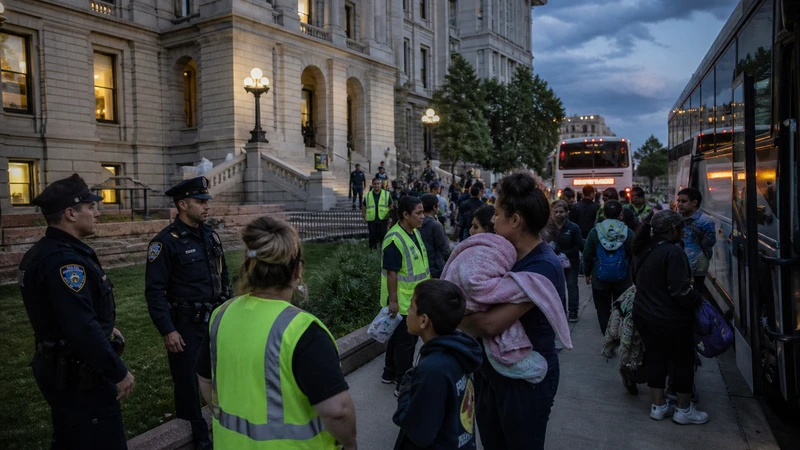
The most visible pressure has been shelter. New York City, Chicago, Denver, and other jurisdictions have spent large sums responding to new arrivals, including people sent from border states and people arriving on their own. New York’s long-standing right-to-shelter rules have made the issue especially acute there, but the pattern is broader: when large numbers of people arrive without housing, work authorization, or established support networks, city services become the backstop.
Schools feel the effects next. Public education is, rightly, open to children regardless of immigration status under Supreme Court precedent. But legal access does not create classroom space, bilingual staff, special services, or transportation capacity out of thin air. Districts absorbing large numbers of new students must pay for English-language instruction, social services, and enrollment growth. These are not abstract culture-war costs. They are line items that compete with teacher salaries, building repairs, and programs for children already in the system.
Hospitals and clinics face a similar problem. Emergency rooms cannot and should not turn away the sick. Yet uncompensated care does not vanish because it is morally necessary. It is shifted—to hospitals, state programs, insured patients, and taxpayers. In communities already struggling with rural hospital closures or urban emergency room crowding, immigration-related demand becomes one more weight on a system not designed for unlimited intake.
Local law enforcement and courts also become involved, not because most illegal immigrants commit crimes, but because any large population living in legal uncertainty creates administrative and public safety complications. Police departments must navigate language barriers, identity verification, trafficking concerns, and sometimes limits imposed by sanctuary policies. County jails and local courts can be left managing consequences of federal enforcement choices they did not make.
The Border Is National; the Invoice Is Local
Here is the imbalance at the heart of the matter: immigration policy is federal, but many of the costs are municipal and state. Washington sets asylum rules, parole policies, detention capacity, and enforcement priorities. Local governments then house people, educate children, provide emergency care, and manage public order.
That mismatch creates political temptation on both sides. Border-state governors can send migrants to northern cities to force attention to a problem they have long faced. Big-city officials can blame Washington while sometimes defending local sanctuary policies that make enforcement cooperation harder. The national parties then retreat to familiar scripts: one side speaking as though enforcement is cruelty, the other sometimes speaking as though hardship cancels human dignity.
Neither script is enough. The rule of law is not a decorative concern. It is what makes ordered generosity possible. If legal immigration is slow, illegal entry is tolerated, asylum claims take years, and removals are rare after a claim fails, the predictable result is more illegal immigration. People respond to incentives. So do smugglers. So do employers who benefit from a shadow labor market while communities absorb the costs.
Policy Choices That Would Help
A serious response would begin with the admission that the current system is unfair in several directions at once. It is unfair to citizens in crowded public systems. It is unfair to legal immigrants who waited and followed the rules. It is unfair to migrants who are lured into dangerous journeys by a system that hints at entry without offering stable legality. And it is unfair to local officials expected to solve a federal failure with municipal budgets.
Several reforms deserve renewed attention:
- Faster asylum adjudication. A claim that takes years to resolve becomes an incentive to enter and remain. More immigration judges, clearer standards, and faster decisions would help legitimate refugees and discourage weak claims.
- Reliable removal after due process. If a person receives a full hearing and lacks a legal basis to remain, removal must be more than a theoretical possibility. A law that is not enforced becomes advice.
- Worksite enforcement and employment verification. The job magnet matters. Expanding effective verification, while protecting small businesses from unnecessary red tape, would reduce the demand that fuels illegal labor markets.
- Targeted federal reimbursement. If Washington’s policies impose costs on cities, the federal government should help pay for emergency shelter, education, and health care burdens—but aid should be tied to cooperation with lawful enforcement.
- Limits on open-ended parole and clearer border authority. Temporary legal tools should not become substitutes for congressional immigration law.
None of this requires abandoning America’s tradition as a nation of immigrants. It requires defending the conditions that make that tradition sustainable. The difference between a door and a breach is not hostility. It is order.
A Moral Duty to Citizens and Strangers
There is a Christian way to think about this, though it will not fit neatly into either party’s slogans. Scripture commands concern for the stranger, but it does not command the abolition of borders or the neglect of one’s household. A humane society must care about the migrant family sleeping in a bus station. It must also care about the working-class American family whose school, clinic, wages, and rent are affected by policy choices made far away.
The deeper danger is that disorder teaches everyone cynicism. Migrants learn that the law is something to be gamed. Citizens learn that compassion is a word used to excuse official incompetence. Local leaders learn to beg for emergency money rather than demand structural reform. And Washington learns, as it too often does, that failure can be exported.
Illegal immigration’s strain on local communities is therefore not just a budget story. It is a test of political seriousness. A serious nation can welcome immigrants, protect refugees, enforce its laws, and respect taxpayers. An unserious nation chooses sentiment one day and backlash the next.
The path forward is not cruelty. It is clarity. The border must mean something. The asylum system must move quickly enough to be trusted. Employers must not profit from illegality while communities pay the bill. And local governments should not be left to manage, with shelter beds and school buses, a national government’s refusal to decide.