
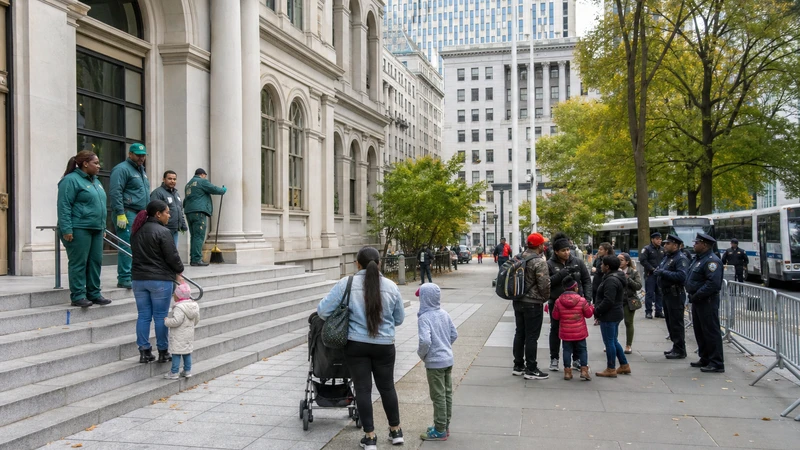
Washington’s Border Failure Is Now a Local Budget Problem
For years, immigration was debated in Washington as a border issue, a national security issue, or a humanitarian issue. It is still all of those things. But in city halls, county hospitals, school districts, and police departments across the country, it has become something more immediate: a budget issue.
Illegal immigration and the broader surge of unauthorized migration have put local communities in a position they were never designed to occupy. Cities do not control the border. School boards do not set asylum policy. County hospitals do not decide who is paroled into the country or who receives a court date years in the future. Yet these institutions are the ones that must absorb the practical consequences when federal policy fails to match federal responsibility.
This is the part of the immigration debate that often gets lost. It is possible to speak with real sympathy for migrants, many of whom are fleeing poverty, disorder, or violence, while also admitting that compassion without limits is not a policy. A town budget is not a moral abstraction. It is a set of trade-offs. Money spent on emergency shelter cannot also be spent on road repairs, teacher salaries, addiction treatment, or police overtime. The bill eventually comes due, and local taxpayers are usually the ones asked to pay it.
The Pressure Points: Shelter, Schools, Health Care
The most visible pressure has been shelter. New York City, Chicago, Denver, and other municipalities have spent heavily to house migrants arriving from the border or sent north by state officials. Some of these migrants are seeking asylum and are awaiting hearings. Others crossed unlawfully and remain in legal limbo. The categories matter legally, but to local administrators the immediate question is simpler: Where do people sleep tonight?
New York City, because of its unique right-to-shelter obligations, has faced especially high costs. Chicago and Denver have also struggled with temporary housing, food, transportation, and basic services. Smaller communities face a different but equally difficult problem: they often lack the bureaucratic machinery that large cities can deploy. A sudden increase in non-English-speaking students, for instance, can strain a school district that already has tight staffing and limited classroom space.
Public schools are required to educate children regardless of immigration status, a principle the Supreme Court affirmed in Plyler v. Doe in 1982. That rule reflects a humane and practical judgment: children should not be punished for the legal situation of their parents. But the cost is real. Districts may need more English-language instruction, additional counselors, transportation changes, and social services coordination. These needs do not arrive with a federal reimbursement check attached.
Hospitals face similar pressures. Emergency rooms are legally and morally bound to treat people in urgent need. County health systems, especially in border states and major destination cities, often become the medical safety net for uninsured migrants. Again, this is not an argument for turning away the sick. It is an argument against pretending that the system can absorb unlimited demand without consequences for everyone else waiting in line.
A Federal Responsibility Shifted Downward
The American immigration system has two related failures. The first is weak enforcement at the border and in the interior. The second is a legal process so slow that it encourages people to enter first and resolve status later, if at all. When asylum claims take years to adjudicate, the process itself becomes an incentive. Even a weak claim can function as a temporary ticket into the country if the government lacks the capacity to make timely decisions.
Federal data from U.S. Customs and Border Protection showed record or near-record pressure at the southwest border during the early 2020s, with encounters reaching historic highs in fiscal year 2023. The numbers moved down after the Biden administration announced tighter asylum-related restrictions in 2024, but that only underscored the point conservatives had been making: policy choices matter. When rules are loosened or enforcement becomes uncertain, more people come. When rules are tightened, the flow changes.
The ordinary citizen understands this better than many experts. A law that is not enforced is not merely a weak law. It is an invitation. And when the invitation is sent by Washington, the response is handled by mayors, sheriffs, teachers, nurses, and charity workers.
The Moral Case for Order
Conservatives should be careful here. It is easy to reduce migrants to costs, and that is neither Christian nor decent. Every person crossing the border is a human being made in the image of God, not a line item. Many are acting out of desperation. Many would be excellent neighbors, workers, and citizens if admitted through an orderly and lawful system.
But order is not the enemy of mercy. It is one of mercy’s conditions. A society that cannot say who may enter, who may remain, and under what terms will eventually lose the public consent that makes generosity possible. When citizens believe the rules are fake, they do not become more compassionate. They become more suspicious, more resentful, and more tempted by crude political answers.
This is the danger now. The longer Washington fails to enforce the law and modernize the legal immigration system, the more the issue moves from policy debate to social fracture. Local residents see services stretched. Migrants see promises they cannot fully redeem. Police and hospitals become the first responders to a federal breakdown. Everyone is asked to improvise around a system that no longer commands confidence.
What a Serious Policy Would Do
A serious immigration policy would begin by restoring border credibility. That means faster asylum screening, more immigration judges, clearer detention and removal authority for those without valid claims, and a reliable employment verification system that reduces the job magnet for unlawful labor. It also means cooperation with state and local officials rather than treating their concerns as political theater.
Congress should also separate what too often gets fused together. Legal immigration can be generous and orderly. Border enforcement can be firm and humane. Work visas can be reformed without rewarding unlawful entry. Asylum can remain available to the truly persecuted without becoming a back door for economic migration. These distinctions are not technicalities. They are the difference between government and drift.
There is also a case for targeted federal aid to communities bearing extraordinary costs, but aid cannot become a substitute for enforcement. Otherwise Washington merely pays local governments to manage the consequences of its own negligence. That is not reform. It is laundering responsibility through municipal budgets.
The country needs a better bargain: lawful entry for those admitted, swift consequences for those who are not, and real support for the communities asked to handle the transition. The alternative is the arrangement we have now, in which national leaders debate virtue while local officials count beds, classrooms, and unpaid bills.
Immigration has always tested America’s ideals. It asks whether we can be welcoming without being foolish, lawful without being cruel, and generous without abandoning the citizens to whom government owes its first duty. The answer cannot be found in slogans about open doors or sealed walls. It has to be built in the ordinary machinery of responsible government.
That machinery is badly in need of repair. Until Washington fixes it, the strain will keep landing where it least belongs: on the local communities that did not write the rules, but must live with their failure.