Pastors Reenter America’s Moral Public Square
There is an old American habit of asking pastors to speak boldly in times of moral crisis, and then scolding them when their words become inconvenient. We admire the minister who denounces some past injustice with the safety of hindsight. We are less comfortable with the living pastor who looks at the headlines and suggests that the Gospel might have something to say about them.
That tension is returning with unusual force. In congregations across the country, clergy are being asked, implicitly or directly, to address abortion after Dobbs, gender and parental rights disputes in schools, rising antisemitism, immigration, crime, loneliness, family breakdown, addiction, war, and the proper limits of government power. These are not merely political issues, though every one of them has a political dimension. They are arguments about what a human being is, what a family is for, what obligations citizens owe one another, and whether moral truth exists outside the preferences of the moment.
In other words, they are exactly the kinds of questions religion has always claimed some authority to address.
The Law Allows More Than Many Think
One reason pastors hesitate is legal caution. Churches and many religious ministries are organized under section 501(c)(3) of the tax code. Since the 1950s, under what is commonly called the Johnson Amendment, those organizations have been prohibited from endorsing or opposing candidates for public office if they wish to keep their tax-exempt status.
But that legal line is often misunderstood. Churches may preach on moral issues. They may teach about public policy. They may encourage voting, host nonpartisan voter registration efforts, and speak about legislation. What they may not do, as tax-exempt charities, is become arms of a campaign.
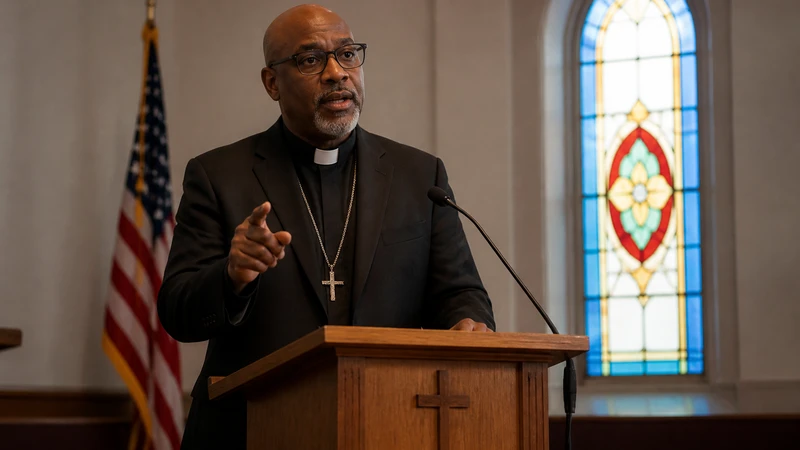
That distinction matters. A pastor who says that the unborn child has dignity, that marriage and family are social goods, or that religious liberty must be protected is not necessarily engaging in partisan politics. He is doing what religious teachers have always done: applying moral doctrine to public life. A pastor who tells the congregation which candidate God has chosen, or treats a party platform as if it were a creed, has crossed into something more dangerous than a tax problem. He has confused the church with the precinct office.
History Cuts Against Silence
American history does not support the idea that clergy should speak only about private piety. Ministers were central to abolitionist activism. Black churches were indispensable to the civil rights movement. Catholic bishops, evangelical pastors, mainline Protestant leaders, rabbis, and other religious figures have all shaped debates over war, poverty, education, marriage, abortion, and religious freedom.
This history is sometimes invoked selectively. Progressives often celebrate religious activism when it serves causes of racial justice or immigration reform, while growing uneasy when clergy defend unborn life or traditional sexual ethics. Conservatives can make the opposite mistake, praising pulpit courage on abortion and religious liberty while dismissing sermons on poverty, prison conditions, or the treatment of migrants as liberal politics in clerical dress.
The better standard is not whether the message helps our side. The better standard is whether the message is rooted in the tradition the minister claims to represent, offered with intellectual honesty, and directed toward forming consciences rather than manipulating ballots.
The Conservative Case for Moral Clarity
A healthy conservatism should not want a politics emptied of moral and religious language. The American experiment rests on a claim about human dignity that government did not invent. The Declaration of Independence speaks of rights endowed by a Creator. The Constitution, in turn, limits the state in part because the person is more than a creature of the state.
When pastors withdraw entirely from public moral questions, they do not create neutrality. They leave the field to activists, bureaucracies, entertainment companies, social media platforms, and political campaigns. The result is not a less moralistic society. It is a society moralized by less accountable institutions.
Parents see this most clearly. When schools teach controversial ideas about sex, identity, race, or the meaning of citizenship, the question is not whether values will be taught. Values are always being taught. The only question is which values, and by whom. A pastor who helps parents think clearly about conscience, authority, childhood innocence, and the duties of family life is not intruding into politics. He is helping them live as responsible citizens and believers.
The same is true on abortion. Since the Supreme Court returned abortion law to the states, legislatures have become the front line of a profound moral argument. Churches cannot write every statute, and pastors should be careful about pretending that prudential policy questions are always simple. But they can say, without apology, that human life is not disposable and that women facing crisis pregnancies deserve more than slogans from either side.
The Danger of Partisan Capture
Still, the risks are real. The pulpit has a peculiar power because people come to it with trust. That trust can be abused. A pastor who turns every sermon into a cable news segment will eventually train his congregation to hear Scripture as background music for political resentment.
This is one reason institutional restraint matters. Churches should address moral issues at the level of principle before they descend into the tactics of party politics. They should distinguish between nonnegotiable truths and prudential judgments. A Christian can insist that the poor have moral claims on the community while debating the best welfare policy. He can defend the duty of a nation to maintain borders while also insisting that migrants be treated as human beings. He can condemn antisemitism without baptizing every foreign policy decision as sacred.
That kind of careful speech is harder than applause-line politics. It is also more useful.
What Faithful Public Witness Requires
For pastors and clergy, the task ahead is not silence, and it is not partisanship. It is formation. The minister’s first responsibility is to tell the truth about God and man, sin and grace, justice and mercy. If those truths never disturb the politics of the congregation, then something has gone wrong. But if they always disturb only the other party, something has gone wrong as well.
Congregations should expect clergy to address the moral questions shaping American life. They should also expect them to do so with seriousness: no cheap conspiracy theories, no casual demonization, no treating political opponents as beyond persuasion or redemption. The church should form citizens who can argue without hatred, vote without idolatry, and lose without despair.
In a disoriented country, that would be a public service of no small value. America does not need pastors to become politicians. It has plenty of politicians already. It needs clergy willing to remind the nation that beneath our policy disputes are deeper questions: What is true? What is good? What kind of people are we becoming?
Those questions cannot be outsourced to Washington. They belong, in part, to the pulpit. And if pastors do not ask them, someone else will answer them for us.