Faith, Security, and America’s Israel Debate
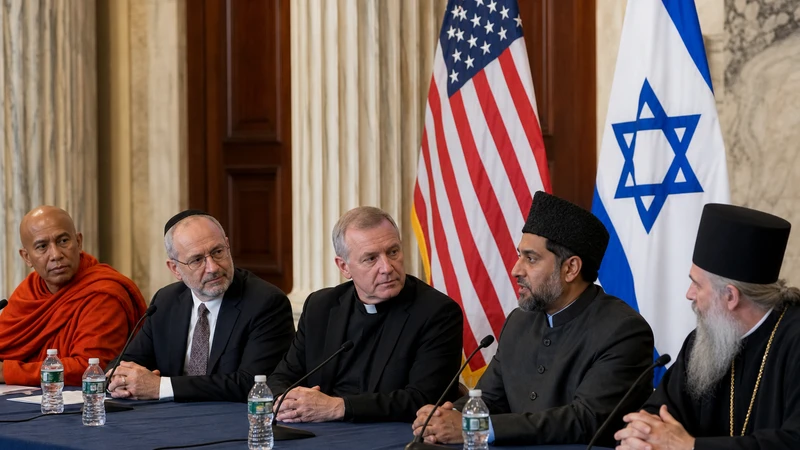
America’s alliance with Israel has never been merely a matter of strategy. It has always lived, at least partly, in the realm of belief: belief about democracy, covenant, history, persecution, prophecy, justice, and national duty. That is why the debate over U.S. support for Israel does not divide neatly along ordinary foreign-policy lines. It runs through churches, synagogues, mosques, campuses, and family tables.
Since Hamas’s attacks on Israel on Oct. 7, 2023, and the war in Gaza that followed, American faith communities have spoken with unusual urgency. Some have pressed Washington to maintain strong military and diplomatic support for Israel. Others have demanded a cease-fire, stronger limits on arms transfers, and greater concern for Palestinian civilians. Many have tried to hold both convictions at once: that Israel has a right to defend itself against terrorism, and that Palestinian life has equal moral worth before God.
That tension is now part of the political landscape. It affects congressional votes on security assistance, debates over antisemitism and anti-Muslim discrimination, campus protests, humanitarian aid, and the future of the Democratic and Republican coalitions.
Evangelicals Remain Israel’s Strongest Religious Base
Among American Christians, white evangelicals have long been the most consistently pro-Israel constituency. Their support is often described as theological, and that is true, but incomplete. Christian Zionism, especially in its popular evangelical form, sees the modern state of Israel as connected in some way to biblical promises to the Jewish people. But evangelical support for Israel also reflects more ordinary conservative instincts: sympathy for a democratic ally, distrust of Islamist militancy, and a post-9/11 view of the Middle East shaped by terrorism and national security.
This helps explain why Republican politicians continue to speak of Israel in moral as well as strategic language. For many churchgoing conservatives, Israel is not just another ally. It is a small nation surrounded by hostile forces, a refuge for a historically persecuted people, and a partner in a dangerous region. In that imagination, abandoning Israel would not be prudence. It would be betrayal.
Yet even within evangelicalism, generational differences are visible. Younger evangelicals are often less formed by Cold War-era conservatism and more exposed to global humanitarian activism. They may still oppose Hamas and support Israel’s existence, while also asking harder questions about civilian suffering in Gaza and the moral limits of military force. The old reflexive consensus has not disappeared, but it has become less automatic.
Jewish Americans Hold Unity and Argument Together
For Jewish Americans, the U.S.-Israel relationship is both intimate and complicated. The attacks of Oct. 7 produced grief and fear across a wide range of Jewish institutions, from Orthodox communities to Reform synagogues to secular Jewish organizations. The rise in reported antisemitic incidents after the war began intensified the sense that Israel’s security and Jewish safety are not abstract subjects.
But American Jewish opinion is not monolithic. Many Jewish organizations strongly support continued U.S. aid to Israel and argue that Hamas’s conduct makes Israeli self-defense unavoidable. Others, including some younger and progressive Jewish groups, have criticized Israel’s military campaign and called for major changes in American policy. The argument is often fierce because it is familial. It is an argument over what Jewish memory requires: uncompromising security after centuries of persecution, or a special obligation to defend the vulnerable because Jews know what vulnerability means.
American policymakers sometimes prefer simpler categories. Religious communities rarely oblige them.
Catholics Emphasize Just War and Human Dignity
Catholic opinion on Israel tends to be less unified politically than evangelical opinion, and more shaped by the church’s moral vocabulary around just war, civilian immunity, and care for Christians in the Holy Land. The Catholic Church recognizes Israel’s right to exist and has developed deepened relations with Judaism since the Second Vatican Council. At the same time, Catholic leaders often speak with urgency about Palestinian civilians, refugees, and the small Christian communities caught between larger powers.
This gives many Catholics a double instinct. They reject antisemitism and understand the necessity of Israeli security. But they also ask whether military action is proportionate, whether civilians are being adequately protected, and whether American policy is doing enough to preserve a future beyond permanent war. In Catholic terms, the moral test is not whether one side has a just cause alone. It is also whether the means remain just.
That framework matters for U.S. policy. It pushes conservatives, in particular, away from a view in which loyalty to an ally means refusing all scrutiny. Friendship among nations, like friendship among persons, should include truth-telling.
Mainline Protestants, Muslims, and the Humanitarian Argument
Mainline Protestant denominations have often approached the issue through human rights, peacemaking, and concern for Palestinian Christians. Many church bodies have debated divestment, occupation, settlement policy, and the terms of a two-state solution. Their statements usually criticize Hamas’s violence while also placing heavy emphasis on Palestinian suffering and international law.
American Muslims have been among the most vocal critics of U.S. support for Israel’s war in Gaza. For many Muslim communities, the images from Gaza are not distant foreign news but a wound felt in religious and familial terms. They argue that Washington’s military support for Israel has made the United States morally responsible for the scale of destruction. This sentiment has had political consequences, especially in states with sizable Arab American and Muslim populations.
Here, too, the debate is not simply foreign policy wearing religious clothing. It is about whether American power is seen as a shield for order or as an instrument of double standards. That perception will affect U.S. credibility far beyond the Middle East.
The Conservative Policy Challenge
An institutional conservative view should begin with a plain recognition: Israel is a legitimate state and a long-standing American ally facing real enemies. Hamas is not a civil-rights organization with a military wing. It is an Islamist terrorist group that deliberately targeted civilians and embeds its war within civilian spaces. Any serious U.S. policy must begin there.
But seriousness does not end there. The United States also has interests that are broader than any single ally’s immediate decisions. Those interests include regional stability, the protection of civilians, the defeat of terrorist groups, the safety of Jewish Americans and Muslim Americans at home, and the prevention of a wider war. Supporting Israel should not require pretending that every Israeli policy is wise. Pressing Israel should not require forgetting why Israelis fear concessions made under fire.
The better conservative position is neither blank check nor moral preening. It is conditional solidarity: maintain Israel’s qualitative military edge, oppose diplomatic efforts that delegitimize the Jewish state, insist on the return of hostages and the defeat of Hamas’s governing capacity, but also use American leverage to encourage humanitarian access, civilian protection, and a political horizon that does not leave Israel ruling indefinitely over a hostile population.
Why Faith Still Matters
In a more secular age, commentators often treat religious language as decoration placed atop real interests. That misses something important. Faith communities care about Israel and the Palestinians because they believe the land is not just territory, human beings are not just units of policy, and history is not merely a sequence of power struggles.
This can ennoble the debate, and it can also distort it. Religion becomes dangerous when it turns suffering into a team sport, when every death is measured first by whether it helps our side. But faith at its best reminds politics that justice and mercy are not inventions of the State Department. They are older than the modern state, and more demanding than any party platform.
America’s role as Israel’s ally will remain contested because America itself remains a religiously plural country with different memories and moral instincts. The task for policymakers is not to erase those differences. It is to govern through them with clarity: defending allies, restraining enemies, protecting innocents, and remembering that the Holy Land is called holy for reasons that should make all sides speak a little more carefully.