
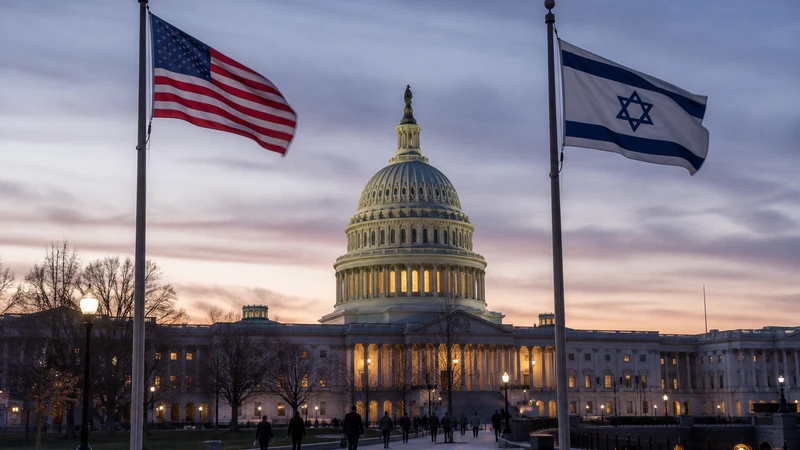
Washington’s Israel Aid Debate Is Really About America’s Role
Foreign aid debates in Washington usually follow a familiar script. One side speaks of alliances, deterrence, and moral obligation. The other speaks of blank checks, domestic needs, and the risk of being dragged into other people’s wars. But the argument over U.S. aid to Israel has become something more complicated than the old debate between internationalists and isolationists.
It now divides Democrats over the war in Gaza, tests Republicans over spending and foreign commitments, and raises a constitutional question that should concern conservatives in particular: who decides when America sends weapons to an ally, Congress or the president?
Israel remains the largest cumulative recipient of U.S. foreign assistance since World War II, according to the Congressional Research Service. Under a 2016 memorandum of understanding negotiated during the Obama administration, the United States committed to providing Israel with $38 billion in military assistance over fiscal years 2019 through 2028. That includes $3.3 billion a year in foreign military financing and $500 million annually for missile defense cooperation.
After Hamas attacked Israel on Oct. 7, 2023, killing civilians and taking hostages, Congress moved to provide additional support. In 2024, lawmakers approved a broader national security package that included major military aid for Israel, along with humanitarian assistance related to the conflict. The package passed after months of partisan and intraparty fighting over Israel, Ukraine, border security, and federal spending.
That fight has not ended. It has merely changed shape.
A Debate Inside Both Parties
Among Democrats, the central dispute is whether U.S. military aid should come with more explicit conditions tied to Israel’s conduct in Gaza. Progressive lawmakers and some human rights advocates argue that Washington cannot fund weapons transfers while civilian casualties, displacement, and shortages of food and medicine dominate the war’s aftermath. They point to existing U.S. laws, including restrictions on assistance to foreign military units credibly accused of gross human rights violations, and say those standards should be applied rigorously.
More pro-Israel Democrats counter that Israel is fighting an enemy that embeds itself among civilians, rejects coexistence, and still holds the moral responsibility for beginning the war with atrocities against Israeli communities. They argue that weakening Israel under fire would not produce peace, but would embolden Hamas, Hezbollah, Iran, and other hostile actors.
Republicans have their own division. Most GOP lawmakers continue to support strong military aid to Israel, seeing it as a strategic ally in a region where American influence has narrowed and Iranian power has grown. But a smaller, louder faction on the right questions foreign aid more broadly. For them, aid to Israel sits inside a larger complaint: Washington seems able to find money for allies abroad while failing to secure the southern border, reduce debt, or rebuild American industry at home.
That objection should not be dismissed as mere isolationism. Conservatives are supposed to care about stewardship. A nation that cannot control its spending will eventually find its foreign policy constrained not by prudence, but by arithmetic. Still, prudence is not the same thing as retreat. The question is whether aid to Israel serves a concrete American interest. In this case, the answer is still yes.
Why Israel Aid Is Different
Not all foreign aid is created equal. Some of it is humanitarian relief. Some is development assistance. Some is security assistance meant to strengthen governments that may or may not share American values. Israel aid belongs mostly in the military category, and much of it is spent through U.S. defense channels. It helps Israel maintain its qualitative military edge in a hostile neighborhood, supports missile defense systems such as Iron Dome and David’s Sling, and reinforces an ally that shares intelligence and military technology with the United States.
There is a common temptation in politics to treat every dollar sent abroad as a dollar burned. But military aid to Israel is better understood as part of America’s security architecture. It is less like charity than like reinforcing a load-bearing wall in a house we still live in.
The Middle East is not a distant moral seminar. It is a region where Iran arms proxies, shipping lanes matter, energy markets can still shake the global economy, and terrorist groups have repeatedly shown the capacity to turn local safe havens into international threats. Israel is not a perfect ally, because there are no perfect allies. But it is a serious one, and in foreign policy seriousness counts for a great deal.
The Problem With Blank Checks
At the same time, supporters of Israel should avoid a lazy argument: that any oversight equals betrayal. Congress has both the authority and the duty to ask how American weapons are used. Conservatives, especially, should resist the idea that executive agencies may conduct foreign policy without meaningful legislative scrutiny.
The Biden administration’s 2024 decision to pause one shipment of heavy bombs amid concern over Israel’s planned operations in Rafah showed how easily arms transfers can become instruments of presidential pressure. Republicans objected, arguing that the administration was undermining an ally during wartime. The House responded by passing legislation aimed at limiting the administration’s ability to withhold certain assistance to Israel, though the broader dispute reflected a recurring tension: presidents want flexibility, while Congress wants control over money it has appropriated.
There is no simple formula here. A president must have room to manage crises. Congress must not be reduced to an ATM with a flag pin. The constitutional balance requires both energy in the executive and seriousness in the legislature. Too often Washington offers the opposite: improvisation from the White House and performance from Capitol Hill.
Humanitarian Aid and Moral Clarity
The hardest part of the debate concerns Gaza’s civilians. Conservatives should be clear about two truths at once. Hamas bears responsibility for launching a barbaric attack and for governing Gaza in a way that placed civilians in grave danger. Israel has the right to defend itself and to prevent Hamas from repeating Oct. 7.
But civilian suffering is not made irrelevant by Hamas’s guilt. A Christian moral imagination, and indeed any humane one, cannot look at children without shelter or families without medicine and say that strategic necessity ends the conversation. Humanitarian aid, carefully monitored to prevent diversion by Hamas, is not a concession to Israel’s enemies. It is a recognition that moral order does not disappear in wartime.
This is where Washington’s debate often becomes too small. One faction speaks as though Israel alone is responsible for every tragedy in Gaza. Another speaks as though any concern for Palestinians is naïve or hostile to Israel. Both habits are evasions. Moral seriousness means holding Hamas responsible for its evil, supporting Israel’s legitimate defense, and still caring whether American policy reduces or worsens human misery.
A Conservative Test
The conservative position should be neither a blank check nor a raised drawbridge. It should begin with national interest, respect constitutional process, and remember that alliances are not sentimental projects. They are commitments made in a fallen world, where power matters because evil is real.
That means continuing military assistance that helps Israel deter Iran and defend its people. It also means regular oversight, clear reporting to Congress, and a sober insistence that U.S. weapons be used in ways consistent with American law and strategic purpose. It means funding missile defense without pretending budgets do not matter. It means providing humanitarian relief without allowing Hamas to turn aid into another weapon.
The debate over U.S. foreign aid to Israel is often described as a fight between conscience and strategy. But the better statesmen have always known that conscience without strategy becomes gesture, and strategy without conscience becomes cynicism. America’s task is to avoid both failures.
Israel’s enemies are watching this debate. So are America’s allies. The message Washington sends should be steady: the United States stands with Israel’s right to survive, expects accountability in the use of American support, and understands that in a dangerous world, abandoning friends is not restraint. It is merely weakness with a better vocabulary.