
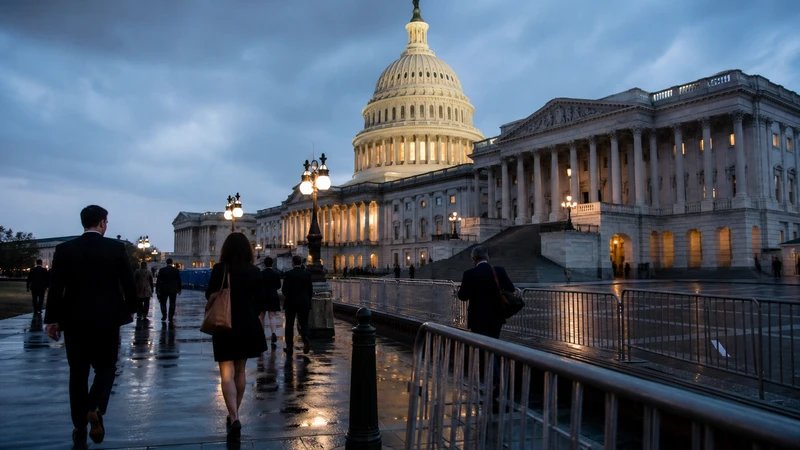
Another Deadline, Another Test of Congressional Discipline
Washington is once again approaching one of its least attractive rituals: the federal funding deadline. Unless Congress passes a spending measure in time, parts of the federal government could shut down, furloughing some federal workers, delaying certain services, and injecting fresh uncertainty into an already unsettled political season.
The immediate question is practical: Can lawmakers agree on a short-term bill to keep agencies open while negotiations continue? The larger question is more serious: Can Congress recover even a modest habit of budgeting, rather than governing from cliff to cliff?
Shutdown fights are often described as battles over numbers, and in one sense they are. Appropriators argue over agency funding levels, policy riders, border security, health programs, defense priorities, disaster aid, and dozens of smaller accounts that rarely make headlines. But these confrontations are also about something less technical and more revealing. They show whether elected officials still believe that public money should be handled with the discipline expected of any responsible household, business, or church parish.
What Is at Stake in a Shutdown
A federal shutdown does not mean the entire government closes. Essential functions continue. Social Security checks are generally still sent. The military remains on duty. Air traffic control, border enforcement, federal law enforcement, and other core operations are typically maintained, though often under strain and with employees working without immediate pay until funding is restored.
But shutdowns are not harmless theater. National parks may close or reduce services. Federal permitting can slow. Some contractors can lose income they never recover. Agencies pause routine work. Families of federal employees face uncertainty, especially those living paycheck to paycheck. The longer a shutdown lasts, the more the inconvenience becomes a genuine burden.
That is why both parties usually insist they do not want one. The difficulty is that each side also wants leverage, and a deadline supplies it. For members who believe spending is too high, the threat of a shutdown may seem like one of the few tools left to force a debate. For members who favor current funding levels or specific domestic programs, resisting cuts may appear equally necessary. In the middle are taxpayers, who are asked to watch the same drama and trust that this time the actors have learned their lines.
The Likely Path: A Continuing Resolution
The most likely temporary answer, as in many past standoffs, is a continuing resolution. A continuing resolution, or CR, extends current funding for a limited period, giving negotiators more time to complete full-year appropriations bills. It is the legislative equivalent of hitting the snooze button.
There are reasonable arguments for a short extension. If the alternative is a disruptive shutdown, a narrow stopgap can be the responsible choice. Government should not be turned on and off like a porch light because legislators cannot finish their work on schedule.
But the repeated use of CRs is also a symptom of congressional failure. The regular appropriations process exists for a reason. It allows lawmakers to examine programs, set priorities, and make trade-offs. When Congress relies on stopgap measures year after year, it locks in old spending decisions and weakens oversight. Agencies plan poorly. Reform gets postponed. The bureaucracy continues by inertia.
There is a moral hazard here that conservatives should understand especially well. If every deadline ends with another extension, then deadlines lose their force. And if every spending dispute is resolved by preserving the baseline, then the growth of government becomes less a choice than a habit.
The Conservative Case for Keeping the Government Open
Some conservatives are understandably skeptical of Washington’s shutdown warnings. They have watched federal spending rise under both parties. They have heard countless promises about future restraint. They know that the budget process often protects the well-connected while asking ordinary citizens to be patient, patriotic, and silent.
Still, there is a conservative case for avoiding a shutdown if a plausible path to spending discipline remains open. Conservatives are supposed to care about institutions, not merely outcomes. A shutdown may display frustration, but it does not by itself reform entitlements, reduce waste, secure the border, rebuild defense capacity, or restore legislative seriousness. It can even make fiscal conservatism look performative rather than practical.
The better conservative posture is not surrender. It is seriousness. Lawmakers should insist on real appropriations work, transparent votes, enforceable spending caps where possible, and fewer gimmicks that move costs outside the public’s line of sight. They should separate urgent funding needs from ideological wish lists. They should also be honest that the biggest drivers of long-term federal spending cannot be solved in a last-minute fight over annual agency budgets.
That last point matters. Discretionary spending is important, and it deserves scrutiny. But the nation’s long-term fiscal challenge also involves mandatory spending, health costs, interest payments, and demographics. Pretending otherwise is like arguing over the grocery bill while ignoring the mortgage, the credit cards, and the leaking roof.
What a Responsible Compromise Could Look Like
A responsible deal would likely have several features. First, it would keep essential services funded and spare federal employees from becoming props in a political contest. Second, it would set a clear and limited timetable for completing full-year appropriations, rather than extending uncertainty deep into the future. Third, it would include serious oversight provisions and, where agreement is possible, targeted reductions in duplicative or lower-priority programs.
Fourth, it should avoid using emergency spending as a back door for ordinary spending. Emergencies do happen, and Congress must respond to them. But if everything is an emergency, then nothing is budgeted. Fiscal discipline depends not only on how much government spends, but on whether lawmakers are willing to name trade-offs honestly.
Finally, leaders in both parties should lower the temperature. A shutdown debate is not improved by treating every opponent as reckless or cruel. Some lawmakers are genuinely worried about debt and inflationary pressure. Others are genuinely worried about the vulnerable people who rely on federal programs. A functioning Congress would be able to acknowledge both concerns without pretending they are identical.
A Test of Political Maturity
The recurring funding deadline has become one of Washington’s small humiliations. It reveals a government powerful enough to spend vast sums, yet often too undisciplined to pass its bills in an orderly fashion. It is like watching a man with a mansion forget to pay the electric bill—not because he lacks money, but because he cannot decide who should be allowed to flip the switch.
For conservatives, the temptation is to see each shutdown threat as a chance to prove resolve. Resolve has its place. But governing is not only a matter of drawing lines. It is also the patient work of building coalitions, counting votes, accepting partial victories, and returning the next day to argue again.
The country needs less budgetary melodrama and more stewardship. Keeping the government open is not the same thing as endorsing every dollar it spends. Demanding restraint is not the same thing as inviting chaos. The task before Congress is to hold those truths together long enough to do its basic job.
If lawmakers can manage that, the immediate deadline may pass without a shutdown. If they cannot, the public will see yet again that Washington’s deepest deficit is not only fiscal. It is institutional trust, slowly spent and not easily replenished.