
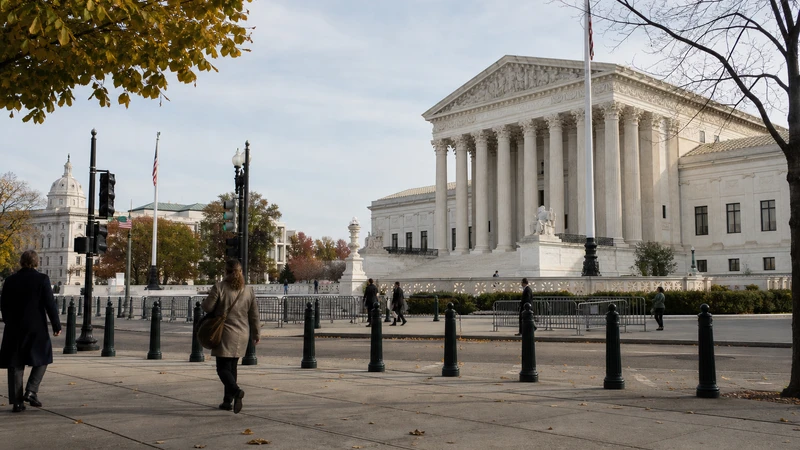
Midterm Results Could Reshape the Federal Courts
Midterm elections are usually described in terms of tax policy, immigration, spending, crime and the political fate of a president. But one of the most lasting consequences of any midterm is often less visible: who gets to wear the black robe.
As the country moves from Election Day into the next Congress, the Democrats' victory in the Senate will determine the pace and character of federal judicial confirmations. That may sound like an inside-Washington concern, the sort of thing that matters mainly to lawyers and activists. It is not. Federal judges decide disputes over religious liberty, executive power, gun rights, abortion regulation, environmental rules, election law, criminal procedure and the reach of administrative agencies. They are not legislators, but in a constitutional republic they are guardians of the boundaries within which legislation and executive action must operate.
That is why Senate control matters so much. The president nominates federal judges. The Senate confirms them. And when a judge is confirmed to an Article III court, that judge receives lifetime tenure, subject only to impeachment and removal in rare cases. A two-year Senate majority can therefore shape the law long after that majority has vanished.
Why Senate Control Is the Central Question
The most direct effect of the Democrats' midterm victory will be felt in the Senate Judiciary Committee and on the Senate floor. With the opposing party set to control the Senate, President Trump's judicial nominations could slow dramatically or, in some cases, nearly stop for controversial nominees.
This is not a new development. Judicial confirmations have become more partisan over the last several decades, especially after the Senate changed its rules to allow lower-court nominees to be confirmed by a simple majority rather than facing the old 60-vote threshold. The same logic was later applied to Supreme Court nominations. Those rule changes did not create the judicial wars, but they removed one of the last tools that forced broader consensus.
For conservatives, there is a lesson here that should not be ignored. Institutions matter, but they are only as strong as the habits that sustain them. Once both parties decide that every vacancy is a battlefield, it becomes very difficult to return to the older idea that a qualified nominee from the other party may deserve confirmation. One can regret that change while also recognizing the reality it has produced.
The Lame-Duck Window
Before the new Congress is seated, the current Senate still has a lame-duck session. With Democrats set to take control of the chamber, that period may become a race to confirm pending nominees before the incoming majority takes office.
Administrations often use this window to move nominees who have already received committee approval or who can be brought quickly to the floor. The more controversial a nominee is, the harder that becomes. Attendance, party unity and floor time all matter. So do the priorities of Senate leaders, who may be juggling government funding, defense legislation and other end-of-year business.
There is nothing improper about confirming judges in a lame-duck session. The Senate retains its constitutional authority until the next Senate convenes. But politically, it can become a test of whether the majority views judicial confirmations as ordinary governance or as a last chance to alter the courts before power shifts.
Vacancies Are the Real Currency
The number and location of vacancies will matter as much as the party breakdown. A handful of open seats on influential federal appeals courts may be more significant than a larger number of district court openings. Appeals courts are often the final word in federal litigation because the Supreme Court hears only a small share of cases brought to it.
The D.C. Circuit is especially important because it handles many disputes over federal agencies and executive authority. Other regional circuits shape law on issues ranging from religious accommodation to state election rules. A single appellate appointment can shift the balance of a closely divided circuit, or at least influence how future panels decide difficult cases.
District judges matter too. They manage trials, issue injunctions and often make the first major ruling in high-profile policy disputes. In recent years, nationwide injunctions have made district court decisions even more consequential, though many conservatives have criticized that practice as an invitation for single judges to freeze national policy.
What a Divided Government Means
With Democrats winning control of both chambers of Congress, judicial nominations will become one of the clearest measures of whether Washington can still perform basic constitutional duties. The incoming Democratic Senate can insist on more moderate nominees, slow the pace of confirmations or leave certain seats vacant. It can also revive older norms, including greater deference to home-state senators on district court nominees through the so-called blue slip process.
That approach has arguments in its favor. The federal judiciary should not be treated as a spoils system for ideological lawyers. Presidents are entitled to nominate judges who share their constitutional philosophy, but senators are not required to act as a rubber stamp. Advice and consent is not a ceremonial phrase.
At the same time, a Senate that refuses to consider almost anyone from the other party risks damaging the courts in a different way. Vacancies create delays for litigants, increase caseloads for sitting judges and feed the public suspicion that judging is merely politics by another name. Conservatives, who rightly warn against judicial activism, should also be wary of turning confirmation itself into pure partisan theater.
The Supreme Court Shadow
No discussion of midterms and the judiciary can avoid the Supreme Court, even when there is no current vacancy. The possibility of a retirement or unexpected opening always hangs over Senate elections. With Democrats taking control of the Senate, President Trump could face demands for a more broadly acceptable nominee or, in extreme circumstances, see a seat left open for an extended period.
The Supreme Court’s current conservative majority has already reshaped major areas of constitutional law, most notably through its decisions on abortion, administrative power, religious liberty and the Second Amendment. Future appointments could either reinforce that direction or begin to soften it. Because justices serve for life, the political effects of one Senate election may reach far beyond the immediate news cycle.
The Conservative Stakes
From an institutional conservative perspective, the central question is not simply whether Republican or Democratic nominees win confirmation. It is whether the judges being confirmed understand the proper limits of their office. The best judges are not priests of their own policy preferences. They are servants of text, structure, history and precedent, even when those sources point toward outcomes they might not personally prefer.
This matters because the temptation in our politics is always to treat the courts as a shortcut. If Congress cannot pass a law, sue and find a judge. If an agency cannot persuade the public, stretch a statute and dare the courts to stop it. If a state policy offends national activists, turn every dispute into a constitutional emergency. This is not healthy self-government. It asks judges to do the moral and political work that citizens and lawmakers are supposed to do.
The midterm results will therefore shape more than a confirmation calendar. With Democrats taking control of the Senate, they will help decide whether the federal judiciary continues along its current ideological path, slows under divided control or enters another period of open conflict between the branches. Voters who care about the courts should pay attention not only to slogans about democracy or the Constitution, but to the quieter machinery of nominations, hearings and floor votes.
In politics, the urgent usually defeats the important. Judicial appointments are the exception that proves the rule: they seem quiet at the moment, then speak for decades. The midterms may be over, but the struggle over the courts is just beginning again.