
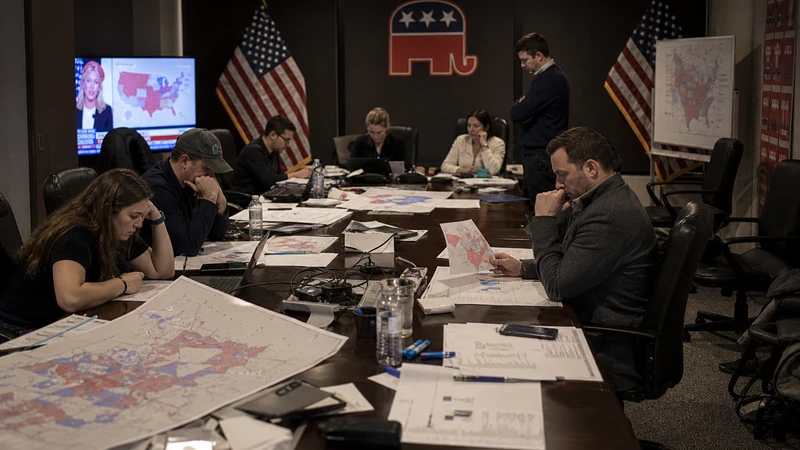
Republicans Confront the Meaning of a Midterm Warning
Midterm losses rarely arrive as a single message, neatly typed and left on a party chairman’s desk. They come instead like a stack of contradictory memos: one district says turnout failed, another says the candidate was weak, another says the national mood curdled, another says voters were anxious about prices, schools, immigration, crime, or simply the tone of politics itself.
That is why the Republican Party’s response to disappointing midterm results will matter almost as much as the results themselves. Elections do not merely distribute offices. They teach parties what kind of country they are trying to persuade. The danger for Republicans now is not that they will draw lessons from defeat. It is that they will draw only the lessons they already preferred before the votes were counted.
For GOP leaders in Washington, state parties, and outside conservative groups, the immediate task is practical: examine where Republican candidates underperformed, where turnout lagged, where independent voters moved away, and where Democratic attacks proved effective. But the deeper question is philosophical and strategic: Is the party building a durable governing majority, or is it relying too heavily on the passions of an already converted base?
The Leadership Question: Accountability Without Panic
After losses, every party experiences a familiar ritual. Consultants blame candidates. Candidates blame consultants. Activists blame leadership. Leadership blames the media. Donors blame everyone. Some of this is unavoidable, and some of it is even useful. Parties are human institutions, and human institutions require accountability.
But accountability is not the same as panic. A serious Republican response would begin with a disciplined review of campaign decisions: recruitment, fundraising, advertising, field operations, early-vote programs, and message testing. It would also look honestly at races where Republicans nominated candidates who pleased primary voters but struggled with the broader electorate.
This is not an argument for ideological surrender. Parties exist to offer choices, not to dissolve into the political center. But the first duty of a political party is to win enough power to govern. A conservatism that cannot persuade beyond its most loyal audience becomes less a governing philosophy than a private club with television ads.
Republicans have faced this problem before. After the 2006 midterms, when Democrats captured both chambers of Congress amid dissatisfaction with the Iraq War and Republican management of Washington, the GOP entered a period of internal conflict over spending, foreign policy, and competence. After 2018, when Democrats won the House in a backlash to the Trump presidency, Republicans debated whether the suburban losses were temporary or structural. After 2022, when many expected a larger Republican wave that did not arrive, candidate quality and abortion politics became unavoidable subjects inside the party.
The current debate belongs in that same line. The details change. The basic lesson does not: voters may be frustrated with Democrats, but frustration alone is not a Republican majority.
Policy Implications: From Protest to Program
One reason midterm setbacks sting is that they expose the gap between opposition and governance. Republicans have been effective in criticizing inflation, border disorder, crime, bureaucratic overreach, progressive cultural excess, and the failures of elite institutions. Much of that criticism is justified. But voters often ask a second question: What would Republicans do, and can they be trusted to do it competently?
On the economy, that means moving beyond general pledges to cut waste and lower costs. A serious agenda would address energy permitting, regulatory burdens, family affordability, health care competition, and the long-term debt. Conservatives do not need to imitate Democratic industrial policy to acknowledge that many working- and middle-class families feel squeezed by housing, child care, insurance, and wages that do not stretch as far as they once did.
On immigration, Republicans have a clearer advantage with much of the public when they emphasize order, enforcement, and the rule of law. But the party still has to decide whether it wants only a border message or a full immigration policy, including legal immigration, labor needs, asylum reform, and the status of people already deeply embedded in American life. Slogans can win a news cycle. Governing requires statutes.
On education, Republicans have gained ground by defending parental rights and criticizing ideological excess in schools. Yet here too, the next step matters. Parents want transparency, but they also want reading scores to improve, classrooms to be safe, and teachers to be competent. School choice, curriculum reform, and local accountability can be powerful conservative answers, provided they are tied to educational results rather than merely cultural combat.
On abortion, the party continues to live in the post-Dobbs world. The Supreme Court’s 2022 decision returned abortion law to democratic debate, which was a constitutional victory for pro-life conservatives. But politically, it also forced Republicans to speak with more precision than many had practiced for decades. Voters distinguish between late-term abortion, early abortion, exceptions, state bans, and support for mothers and children. A pro-life party cannot be content with legal restriction alone. It must show, in policy and tone, that it takes both unborn life and vulnerable women seriously.
The Coalition Problem
The Republican coalition has changed over the last decade. It is more working-class, more skeptical of corporations, less libertarian on trade and foreign policy, and more culturally populist. At the same time, the party still depends on suburban voters, religious conservatives, small-business owners, veterans, rural communities, and an increasingly diverse bloc of Hispanic, Asian, and Black voters open to conservative appeals on family, faith, enterprise, and public safety.
Holding such a coalition together is difficult. But it is not impossible. The key is to remember that coalitions are built through addition, not purification. A party that treats every internal disagreement as betrayal will eventually have a very pure movement and very few elected officials.
Republican leaders can respond in three broad ways.
- First, professionalize the mechanics. Candidate recruitment, ballot operations, data, and early voting cannot be treated as afterthoughts. Democrats have often invested heavily in these unglamorous tools. Republicans cannot afford to regard them as beneath a movement driven by rallies and media moments.
- Second, clarify the agenda. Voters should know what a Republican Congress or Republican administration would prioritize in the first year: border security, energy production, spending restraint, school choice, public safety, and measures to strengthen families.
- Third, discipline the tone. The party need not become timid. But it should understand that persuasion is different from provocation. The voter who is worried about inflation or disorder may still recoil from candidates who seem more interested in grievance than governance.
A Conservative Party Must Conserve More Than Anger
There is a temptation, after losses, to say the answer is simply more aggression: louder rhetoric, sharper attacks, more contempt for institutions, more pressure on internal enemies. This temptation is understandable. Defeat makes parties feel humiliated, and humiliation seeks a language of revenge.
But conservatism, properly understood, is not a politics of permanent rage. It is a politics of stewardship. It asks how a free people can preserve order without smothering liberty, honor tradition without ignoring injustice, and adapt to change without worshiping it. That kind of politics requires more than a mood. It requires patience, prudence, and an ability to speak to people who do not already agree.
The Republican Party does not need to become a moderate party in the sense that editorial boards usually mean the word. It does need to become a more serious party: serious about policy, serious about character, serious about institutional competence, and serious about the difference between winning attention and winning trust.
Midterm losses can be wasted, or they can be used. They can harden every faction in its prior certainty, or they can force a party to ask why voters who were available did not come home. The future direction of the GOP will depend on whether its leaders treat this moment as an insult to be avenged or a warning to be understood.
Politics, like religion, has its false consolations. One of them is the belief that defeat proves only the wickedness of one’s enemies. Sometimes it does. More often, it reveals the work still left undone.