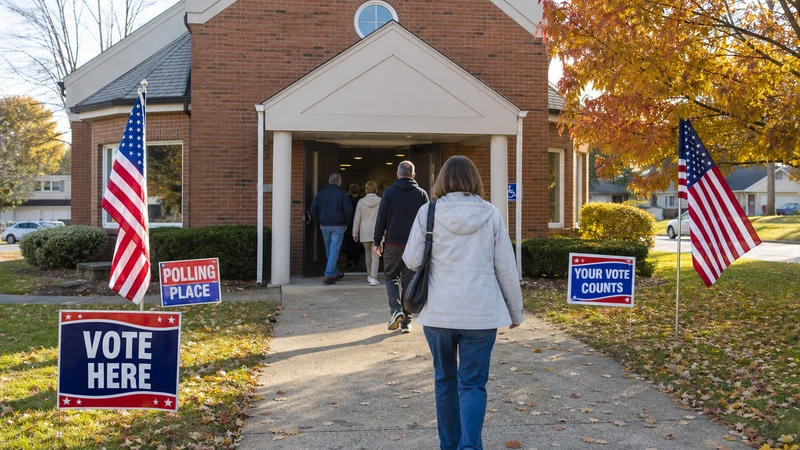
Religious Voters Are Still Religious — But Not Single-Issue
For a generation, the phrase “Christian voter” in American politics has often meant a voter mobilized by the familiar concerns of the religious right: abortion, religious liberty, school policy, sexuality, and the place of faith in public life. Those issues have not disappeared. In many communities, they remain defining questions. But the midterm landscape is reminding both parties of something easy to forget from a distance: churchgoing voters also buy groceries, worry about war, watch candidates on television, and ask whether public men and women can be trusted.
This does not mean social issues have lost their force. It means the hierarchy of concerns has become more crowded. The pastor who preaches about the dignity of life may be speaking to a congregation where parents are also worried about rent, older members are watching retirement accounts, and younger families are trying to afford a first home. Politics, like life, rarely offers a single clean category.
That is the important development for Republicans and Democrats alike. Religious voters are not abandoning moral politics. They are asking whether moral politics has anything serious to say about the whole of public life.
Economics Has Become a Moral Issue
In recent election cycles, polling has consistently shown the economy and inflation among the top concerns for voters overall. That matters especially for religious constituencies that campaigns sometimes treat as if they live only in the culture-war portion of the ballot.
Evangelicals, Catholics, Latter-day Saints, Black Protestants, and Hispanic Christians differ sharply in voting patterns. But across these groups, economic anxiety has a way of cutting through ideological assumptions. A family that sees grocery bills rise does not experience inflation as an abstraction. It experiences it as pressure around the dinner table. A small-business owner in a church pew hears debates about regulation and taxes not as theory, but as payroll, hiring, and survival.
For conservatives, this should be clarifying. A pro-family politics cannot be limited to symbolic gestures or campaign-season invocations of “values.” It has to take seriously the conditions under which families form, work, raise children, and build communities. That includes prices, wages, energy costs, housing, and the burden of government rules that fall hardest on people without lawyers and lobbyists.
The older fusionist formula — moral traditionalism joined to free-market economics — still has life. But it requires renewal. If candidates speak fluently about religious liberty but vaguely about the cost of living, many voters will hear an incomplete message. Christian voters may forgive imperfection. They are less likely to reward indifference.
Foreign Policy Is Back in the Pews
Foreign policy has also returned to the religious voter’s field of vision. Russia’s war in Ukraine, the aftermath of Hamas’s Oct. 7 attack on Israel, conflict across the Middle East, and rising tensions with China have made the world feel less distant than it did in the relatively quiet years after the Iraq War faded from the front page.
For many conservative Christians, support for Israel remains a deeply held instinct, though the reasons vary — theological, strategic, historical, and moral. Catholics and mainline Protestants often bring a different vocabulary, emphasizing just-war reasoning, civilian protection, humanitarian relief, and the limits of military power. Black churches may connect foreign policy with civil rights concerns and the moral credibility of American leadership. Immigrant churches often listen with special attention because foreign crises may involve relatives, former homelands, or persecuted co-religionists.
Here again, the old labels do not do enough work. “Religious voter” does not mean “automatic hawk,” nor does it mean “automatic isolationist.” It often means a voter who wants American policy to reflect prudence, strength, and some recognizable moral purpose. That combination is difficult, and therefore unfashionable. But difficulty is not an excuse for slogans.
The conservative temptation is to reduce foreign policy to toughness. The progressive temptation is to reduce it to humanitarian feeling. Christian realism should resist both. It knows that power is necessary in a fallen world, but it also knows power is dangerous precisely because fallen human beings wield it.
Character Still Matters, Though Not Simply
The hardest question for many religious voters remains candidate character. Since 2016, one of the great embarrassments for American Christianity has been the ease with which moral language can become tribal language. Voters who once insisted that private virtue mattered in public office have sometimes grown quiet when their own side’s champion behaves badly. Their critics, for their part, have not always shown equal concern for character when the flawed candidate advances progressive ends.
So the problem is not unique to one party. It is a problem of political idolatry, which is simply idolatry wearing a campaign button.
Still, character continues to matter, especially in midterms where local candidates are less protected by national celebrity. A Senate candidate, House candidate, governor, or school-board contender cannot always survive on party label alone. Religious voters may ask basic questions: Does this person tell the truth? Does he keep promises? Does she seem to understand the community? Is the candidate’s faith a costume, a weapon, or a real source of discipline?
Those questions do not always produce the same answer. Some voters will support a morally compromised candidate because they judge the policy stakes to be grave. Others will refuse, fearing that winning with such a candidate corrupts the cause being defended. Both positions can be argued. What cannot be argued, at least honestly, is that character has no public consequences.
Abortion and Education Still Shape the Map
None of this should be mistaken for the end of social issues. After the Supreme Court overturned Roe v. Wade in 2022, abortion politics became more state-based, more immediate, and in some places more politically difficult for Republicans. Pro-life voters remain motivated, but the post-Roe environment has forced candidates to speak with greater precision about law, exceptions, federalism, and support for mothers and children.
Education is similar. Parents continue to care about curriculum, school choice, parental rights, and the authority of local communities. For many religious families, schools are not merely service providers. They are institutions that shape souls. That makes education policy a moral issue, not just an administrative one.
But these concerns now sit beside inflation, crime, border policy, foreign instability, and mistrust of institutions. The candidate who treats religious voters as if they need only a few familiar phrases is likely to sound stale. The candidate who connects moral conviction to practical governance may find a more attentive audience.
The Policy Lesson for Conservatives
The immediate political lesson is simple: Republicans cannot take Christian voters for granted, and Democrats should not assume they are unreachable. The deeper lesson is better: religious voters are whole persons, not demographic vending machines. Insert the right phrase, receive the expected vote — that is how consultants think, not how citizens think.
For institutional conservatives, the path forward should be a politics of moral seriousness joined to governing competence. Defend life, but also make adoption, childbirth, and family formation less lonely and costly. Defend religious liberty, but do so in language that persuades neighbors rather than merely signals to friends. Support allies abroad, but explain the national interest and moral limits of American power. Nominate candidates whose lives do not make a mockery of the virtues they invoke.
A democracy cannot live by economics alone. But neither can a religious politics survive if it forgets ordinary burdens. The Christian voter, at his best, is not asking whether politics can become a substitute church. He is asking whether public life can still make room for truth, duty, family, and peace. That is not a narrow agenda. It is almost the whole human question, translated into the language of ballots.