Faith Groups and the Civic Work Before Election Day
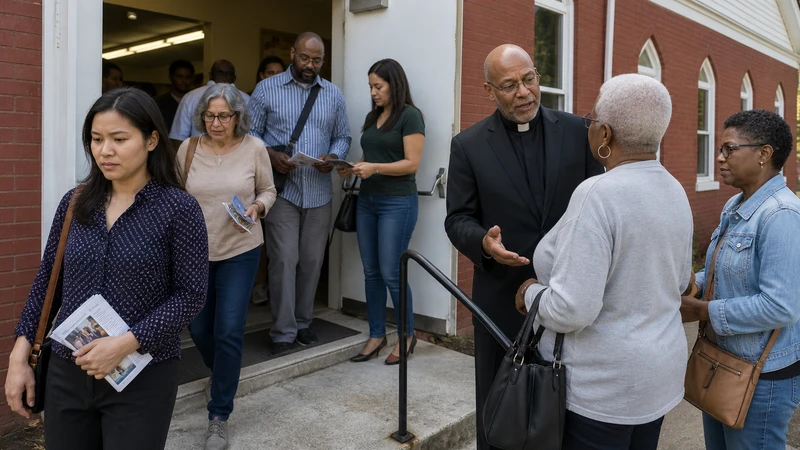
On Election Day, some of the most important political activity in America is not happening at rallies, television studios or campaign headquarters. It is happening in church basements, synagogue social halls, mosque community rooms and parish parking lots, where volunteers are reminding neighbors to vote, offering rides to polling places and helping people understand what will be on the ballot.
This is not new. Religious communities have long served as schools of citizenship in the United States. They teach people how to organize a meeting, raise money, argue without leaving the room, serve the poor and think about obligations beyond the self. In a healthier country, we would not find this surprising. A person who learns every week that his life is accountable to God and neighbor is already learning the first lesson of republican self-government: liberty is not the same thing as isolation.
Still, the renewed visibility of faith-based voter efforts comes at a tense moment. Americans are more politically sorted than in past generations, and houses of worship are not immune from that sorting. Many congregations contain people who vote the same way. Others contain members who quietly disagree but no longer wish to argue. The temptation, for clergy and lay leaders alike, is to mistake political harmony for spiritual unity.
What Faith Communities Can Legally Do
Under federal tax law, churches and other 501(c)(3) nonprofit organizations may conduct nonpartisan civic activity. They can hold voter registration drives, host candidate forums if conducted fairly, distribute neutral voter information and encourage citizens to participate in elections. What they may not do, while keeping that tax-exempt status, is endorse or oppose candidates for public office.
That distinction matters. It is not merely a legal technicality, though the law is real enough. It also protects the integrity of religious institutions. A church that tells its members to vote is fulfilling a civic duty. A church that implies salvation runs through one party is doing something very different. It is trading the pulpit for the precinct office.
For conservatives, especially those who care about the health of mediating institutions, this should be an easy distinction to defend. The state does not create community. Political campaigns do not form souls. Long before most Americans encounter a county party committee, they encounter families, neighborhoods, schools and congregations. These institutions teach the habits that make constitutional government possible. If they weaken, Washington does not become wiser. It merely becomes larger.
A History Larger Than One Party
Faith-based civic engagement has never belonged exclusively to the right or the left. Black churches were central to the civil rights movement, not simply as meeting places but as moral engines. Catholic parishes helped generations of immigrants become citizens and voters. Evangelical churches became increasingly active in public life during fights over abortion, religious liberty and education. Jewish congregations, mainline Protestant churches, Latter-day Saint communities and Muslim civic organizations have all played roles in registering voters and encouraging public service.
That history is a useful corrective to one of the lazier assumptions in modern politics: that religion is just another demographic bloc waiting to be activated. Real religious life is more complicated than that. It includes doctrines, loyalties, rituals, memories, ethnic histories and moral obligations that do not fit neatly into a campaign spreadsheet.
This is why politicians often misunderstand religious voters. They hear the language of values and translate it into the language of turnout. They visit a church and see a room full of possible votes. But the congregation, at its best, is not a market segment. It is a body of people trying, however imperfectly, to order their lives around ultimate things.
The Conservative Case for Civic Participation
There is a serious conservative argument for encouraging faith communities to promote voting. Self-government requires citizens who believe their choices matter and who accept responsibility for the common good. Low participation does not produce moderation or wisdom. It often leaves public decisions to the most organized, the most angry or the most ideologically committed.
Religious institutions can help broaden participation in a way that is personal rather than bureaucratic. A reminder from a neighbor after Sunday service may reach someone who ignores campaign mail. A ride from a deacon or volunteer may matter more than a digital ad. A nonpartisan forum in a familiar building may help citizens hear from local candidates without the noise of national cable politics.
This kind of civic work is especially valuable in local elections, where offices such as school board, sheriff, county commissioner and judge can shape daily life more directly than many federal debates. Faith communities often know the practical concerns of their members: public safety, housing, schools, addiction, family breakdown and care for the elderly. When they help citizens connect those concerns to local government, they strengthen democracy at the level where it is most tangible.
The Danger of Partisan Capture
But there is a danger here, and religious conservatives should be willing to name it clearly. Civic engagement can become partisan mobilization with a hymn attached. When that happens, the faith does not elevate politics. Politics diminishes the faith.
The danger is not only on one side. The religious right can confuse fidelity with voting Republican. The religious left can confuse compassion with voting Democratic. Both can treat Scripture as a collection of useful slogans rather than a word that judges every party and every platform. When God always seems to agree with our preferred candidates, we should at least consider the possibility that we are hearing an echo.
Clergy have a special responsibility here. They need not be silent about moral questions. A pastor, priest, rabbi or imam may speak about the sanctity of life, religious liberty, poverty, racial justice, the dignity of work, marriage, immigration, war and peace. Religious leaders who refuse to speak about public morality are not being neutral; they are often being timid. But there is a difference between moral teaching and campaign management. The first is part of religious leadership. The second is usually a misuse of it.
Policy Implications for 2026 and Beyond
The policy implications are straightforward. Government should protect the right of faith communities to engage in nonpartisan civic activity. Election officials should make it easy for lawful community groups to provide registration information, polling-place guidance and assistance to voters who need transportation or language help. At the same time, public authorities should apply the rules evenhandedly and avoid using tax law as a political weapon against unpopular religious groups.
Election integrity also matters. Encouraging turnout and maintaining trust in the process are not opposing goals. Faith-based groups that assist voters should be careful, transparent and respectful of election rules. Conservatives should not treat every get-out-the-vote effort as suspicious; liberals should not treat every concern about ballot security as suppression. A serious republic needs both participation and confidence.
The deeper issue is cultural. America is suffering not only from polarization but from loneliness and institutional distrust. People who do not belong anywhere are easier to manipulate and harder to persuade. Faith communities, when healthy, offer a remedy more durable than any campaign tactic: belonging ordered toward truth, service and responsibility.
So yes, churches and other religious communities should encourage citizens to vote. They should do so without pretending that the kingdom of God is on the ballot. The act of voting is important, but it is not ultimate. It is one duty among many in a free society, and perhaps its greatest value is that it reminds us we are not spectators.
A republic depends on citizens who show up. Faith, at its best, teaches people why showing up matters.