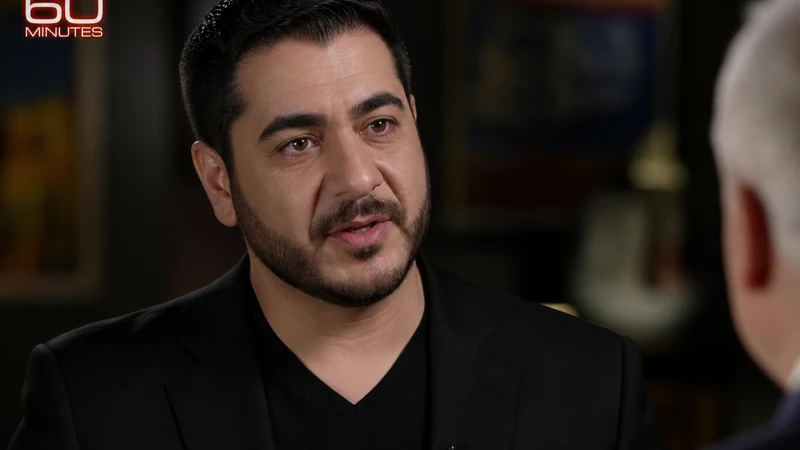
Abdul El-Sayed’s appearance on 60 Minutes has ignited a sharp debate over one of the most basic questions in Middle East politics: whether Israel, the world’s only Jewish state, has an inherent right to exist.
The flashpoint came during an exchange with New York Times columnist Ross Douthat, who pressed El-Sayed on a question often asked of Palestinian advocates but far less frequently reversed.
“I don’t ever get the question of, ‘Does Palestine have the right to exist?’” El-Sayed said.
Douthat immediately responded: “Does Palestine have the right to exist?”
“Yes,” El-Sayed answered.
Then came the follow-up: “Does Israel have the right to exist?”
El-Sayed began to answer, “S— yes. If there is a shared understanding—” before Douthat interrupted, noting the contrast between the straightforward answer on Palestine and the qualified answer on Israel.
That moment matters.
For supporters of Israel, El-Sayed’s hesitation was not a minor stumble or a semantic quirk. It exposed what they see as a deeper problem in progressive discourse: Palestinian national aspirations are treated as self-evident and morally urgent, while Jewish national self-determination is treated as conditional, negotiable, or dependent on approval from others.
El-Sayed went on to say that he believes in “equal rights to peace, dignity, and self-determination for Palestinians and Jewish Israelis alike.” He added that if Palestinians and Israelis choose two states, he would support that; if they choose one shared state, he would support that too.
On the surface, that language sounds even-handed. But the wording also shifts the question away from Israel’s legitimacy as a sovereign Jewish state and toward a procedural vision in which Israel’s continued existence depends on a “shared understanding” between peoples.
That is precisely why the exchange is so revealing.
When asked whether Palestine has a right to exist, El-Sayed said yes. No qualification. No caveat. No discussion of Hamas, borders, recognition, governance, or whether Israelis agree.
When asked whether Israel has a right to exist, he introduced a condition.
For many Jews and Christians who support Israel, that asymmetry is the heart of the problem. Israel’s right to exist is not merely a political preference. It is tied to the Jewish people’s history, security, and survival after centuries of exile, persecution, pogroms, and ultimately the Holocaust. To suggest that this right is conditional in a way that Palestinian statehood is not will sound, to many, like disdain dressed up as neutrality.
The issue is not whether one supports a two-state solution, a one-state arrangement, or another diplomatic framework. Reasonable people can debate borders, settlements, security guarantees, and the failures of Israeli and Palestinian leadership. The issue is whether Israel is granted the same moral legitimacy that its critics demand for Palestine.
In this exchange, El-Sayed did not provide that parity.
His answer reflects a broader trend among some on the political left: the language of universal rights is invoked, but Israel is singled out for conditional legitimacy. The Jewish state is asked to justify its existence in a way few other nations are. Its national identity is treated as suspect. Its sovereignty is treated as provisional. Its legitimacy is often framed as something that must be earned through political concessions.
That standard is not applied evenly.
No one asks whether France has a right to exist only if all its minorities approve of the French constitutional order. No one asks whether Pakistan has a right to exist only if India accepts its founding logic. No one asks whether the Palestinian national movement has a right to exist only if Israelis feel secure enough to consent to it.
But Israel is routinely subjected to precisely that kind of questioning.
The 60 Minutes exchange also highlights the moral burden placed on Jewish Israelis in public debate. El-Sayed’s formulation suggests that Israel’s legitimacy depends on a mutually agreed political arrangement. But Israel was founded in 1948, recognized by the United Nations, and has defended its existence through repeated wars and waves of terrorism. Its right to exist is not a hypothetical question awaiting consensus.
To be clear, acknowledging Israel’s right to exist does not require endorsing every action of the Israeli government. It does not require silence about Palestinian suffering. It does not require opposing Palestinian self-determination. In fact, one can affirm the dignity and rights of Palestinians while also affirming, without hesitation, that Israel has a right to exist as the homeland of the Jewish people.
That should be an easy sentence to say.
El-Sayed’s difficulty in saying it plainly is why the clip is likely to endure beyond the news cycle.
For voters who care about Israel, especially Jewish voters and faith-minded Christians who see Israel as both a democratic ally and a nation with deep historical and biblical significance, the interview will reinforce existing concerns. They will see in El-Sayed’s answer a worldview in which Israel’s legitimacy is always up for debate, while the legitimacy of its adversaries’ national claims is assumed.
That is not balance. It is a double standard.
And in the politics of Israel and Palestine, double standards are never neutral. They shape policy. They shape party coalitions. They shape whether antisemitism is confronted directly or obscured beneath academic language about power and liberation.
El-Sayed may insist that his position is rooted in equality and self-determination for all. But the exchange with Douthat revealed something his carefully chosen language could not conceal: when Palestine’s right to exist was raised, his answer was immediate. When Israel’s right to exist was raised, his answer came with an “if.”
For Israel’s supporters, that “if” says everything.
60 Minutes Exposes Abdul El-Sayed
- by: PolitiChristian
- 2026-11-02
- Source:
politicrossing.com
- 11/02/2026