
A Border Debate That Needs Less Theater
The argument over the southern border has often been conducted as if the country must choose between two cartoons: a great wall stretching from the Pacific to the Gulf, or a purely humane and paperwork-based system that somehow deters unlawful entry by moral aspiration alone. Neither vision is serious enough for the scale of the problem.
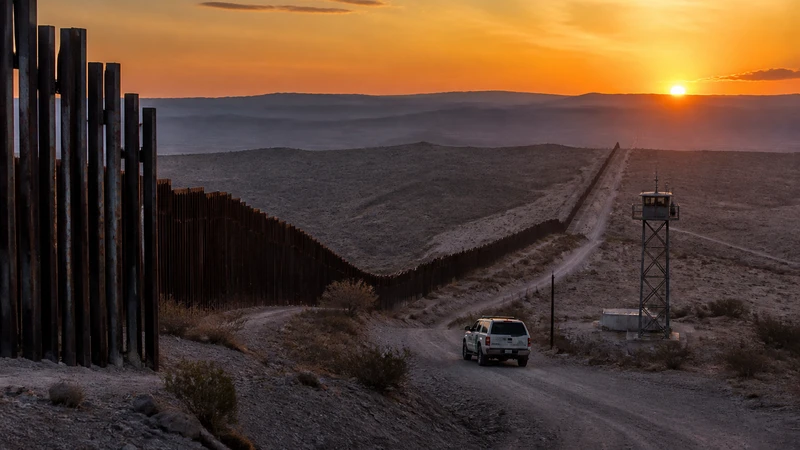
The United States has a border with Mexico of nearly 2,000 miles. It crosses cities, deserts, mountains, ranchland, river country, and tribal lands. Some stretches are well suited for fencing, patrol roads, lights, and cameras. Others are physically difficult, environmentally sensitive, or better handled with sensors and rapid-response teams. A government worthy of public trust should be able to say both things at once.
That is why the renewed debate over barriers and technology matters. The practical question is not whether America should secure its border. A sovereign country has that duty. The question is whether Congress and the executive branch can build a durable system rather than another symbolic fight.
What Physical Barriers Can and Cannot Do
Physical barriers have been part of U.S. border policy for decades. Congress passed the Secure Fence Act in 2006 with bipartisan support, and different administrations have built, replaced, repaired, or redirected barrier projects since then. The Trump administration made the wall the central image of its immigration policy. The Biden administration halted some construction early on, then later allowed limited work in areas where funds had already been appropriated or where officials argued operational needs remained.
This history is useful because it punctures the fantasy that border barriers are either a radical innovation or a complete fraud. They are neither. They are tools.
In urban and high-traffic areas, fencing can slow illegal crossings, funnel migrants toward lawful ports of entry, and give Border Patrol agents time to respond. It can also reduce dangerous foot chases and help protect nearby communities from the constant pressure of crossings through private property. A barrier does not have to be perfect to be useful. A locked door does not make burglary impossible; it makes burglary harder and more visible.
But barriers are not magic. They can be climbed, cut, tunneled under, or routed around. In remote areas, a wall without roads, sensors, lighting, and personnel may become little more than expensive scenery. In river terrain, construction can raise legal and environmental complications. And even the strongest fence does not answer the harder questions of asylum law, worksite enforcement, visa overstays, or drug trafficking through ports of entry.
The conservative case for barriers, then, should be sober rather than romantic. Build where barriers help. Do not pretend steel alone can substitute for state capacity.
The Case for a Layered System
Modern border security increasingly depends on integration. Cameras detect movement. Ground sensors help identify crossing patterns. Drones and aircraft provide wider surveillance. Fixed towers can monitor remote terrain. License-plate readers, inspection technology, and data systems help officers at ports of entry. None of these systems is a border policy by itself. Together, they can turn a vast and difficult frontier into a more manageable security environment.
This is where the old wall-versus-technology argument becomes especially foolish. Physical barriers and technology do different things. A fence delays. A sensor alerts. A camera verifies. A patrol road allows agents to respond. A processing system determines what happens after a person is encountered. Remove any one layer, and the system weakens.
There is also a fiscal point. Conservatives should not assume that every mile of barrier is automatically the best use of money. In some sectors, a tower, road improvement, and mobile response capacity may offer greater value than construction across hostile terrain. In others, replacing an old vehicle barrier with modern pedestrian fencing may be exactly what agents need. The right answer should come from operational assessment, not campaign slogans.
That means Congress should demand clear planning from the Department of Homeland Security: where barriers are needed, where technology is more effective, how maintenance will be funded, how fast agents can respond to detections, and how success will be measured. The federal government is very good at buying things and less good at maintaining systems over time. Border security cannot be treated as a one-time purchase.
Technology Raises Its Own Questions
Conservatives who support stronger enforcement should also be honest about the risks of technological government. Surveillance tools can be useful at the border while still requiring oversight. Drones, towers, artificial intelligence systems, biometric tools, and data-sharing programs must operate under clear rules. Procurement must be competitive and transparent. Civil liberties cannot become an afterthought merely because the border crisis is real.
This is not a liberal objection to enforcement. It is a constitutional objection to sloppiness. A government powerful enough to monitor remote crossings is also powerful enough to misuse data if Congress refuses to supervise it. The answer is not to reject technology, but to govern it carefully.
There is a moral dimension here as well. A chaotic border is not compassionate. It enriches smugglers, exposes migrants to danger, strains local communities, and undermines confidence in legal immigration. But an orderly border should not become a place where bureaucracy forgets that every case involves a human being. The aim should be firmness joined to clarity: lawful entry encouraged, unlawful entry deterred, fraudulent claims rejected, and genuine claims handled promptly.
Ports of Entry Matter Too
A serious border strategy also has to focus on ports of entry, where people and goods move lawfully every day. Much of America’s trade with Mexico depends on efficient crossings. Security that needlessly slows commerce imposes real costs on border states and the national economy. At the same time, criminal organizations use legal crossings and commercial traffic to move contraband, including deadly drugs.
That is why inspection technology, staffing, canine units, intelligence sharing, and modernized infrastructure at ports are not secondary concerns. They are central to border security. A country can strengthen the spaces between ports while still failing if it neglects the gates themselves.
The Missing Ingredient: Political Durability
The larger failure in Washington is not that officials lack border-security ideas. It is that policy swings too sharply with each administration. One president expands construction. The next suspends it. One administration emphasizes deterrence. The next emphasizes processing and parole. The result is a system that signals uncertainty to migrants, smugglers, states, and federal agents alike.
A durable settlement would pair enforcement with legal clarity. It would fund targeted barriers, surveillance technology, patrol capacity, immigration courts, detention space where legally appropriate, and faster removal for those without valid claims. It would preserve asylum for the persecuted while narrowing incentives for weak or fraudulent claims. It would also support legal immigration channels that serve the national interest, because a lawful system works best when the law is not treated as a dead letter.
There is no sacrament in concrete or steel. There is no salvation in software. But there is a basic political obligation that precedes nearly every other debate: the government must be able to say who enters the country and on what terms. If it cannot do that, public trust erodes, and the decent arguments about immigration become harder to have.
The southern border does not need another metaphor. It needs a system: barriers where they work, technology where it helps, agents with the tools to respond, courts that can decide cases promptly, and laws that mean what they say. That may be less stirring than a chant and less comforting than a slogan. But in government, as in much of life, seriousness usually begins when the slogans end.