
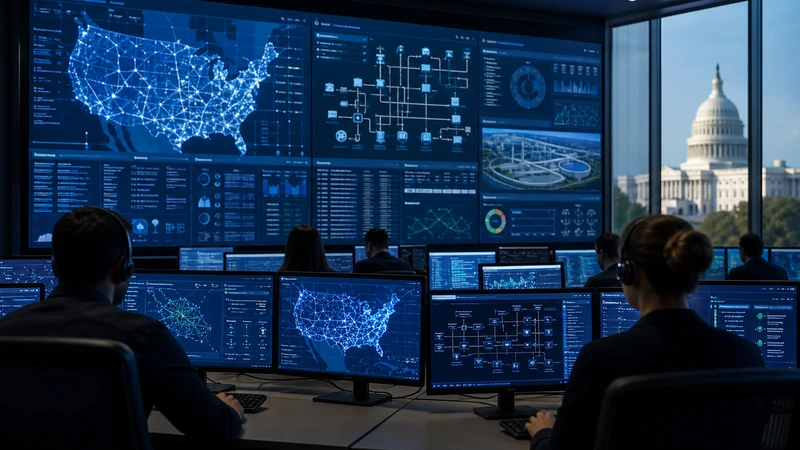
The New Front Line Is Not Always Visible
There was a time when Americans imagined attacks on national infrastructure in physical terms: a bridge destroyed, a power plant bombed, a port blockaded. Those threats have not disappeared. But the more likely danger now may arrive through a vendor’s login, an unpatched server, or a quiet piece of malicious code sitting inside a network no ordinary citizen will ever see.
Cybersecurity threats to critical infrastructure have moved from a specialist concern to a central question of national security. The systems at issue are not abstract. They include electricity, natural gas, water treatment, hospitals, ports, pipelines, communications networks, and financial services. If they fail, the consequences are not confined to a balance sheet. They reach the patient waiting for surgery, the family trying to heat a home, and the small business that cannot process a payment.
This is why recent warnings from federal agencies such as the Cybersecurity and Infrastructure Security Agency, the FBI, and sector-specific regulators deserve more attention than they often receive. The federal government has repeatedly cautioned that hostile nation-states and criminal ransomware groups are probing American systems. Some are seeking money. Others appear to be preparing for leverage in a future crisis. Both deserve to be taken seriously.
From Ransomware to State-Sponsored Intrusions
The public has already seen how cyberattacks can spill into ordinary life. The 2021 ransomware attack on Colonial Pipeline disrupted fuel supplies across parts of the Southeast and produced scenes that looked, for a few anxious days, like something from an older energy crisis. In 2024, the ransomware attack on Change Healthcare disrupted payment and claims systems across the health care sector, imposing stress on hospitals, pharmacies, physicians, and patients.
These episodes were not identical, but they taught the same basic lesson: efficiency has created fragility. Modern America runs on highly connected digital systems. That connectivity gives us speed, convenience, and lower costs. It also means that a software failure or intrusion in one place can produce confusion far beyond its first point of entry.
The threat is not only criminal. U.S. officials have warned about Chinese state-sponsored cyber activity, including the group publicly identified as Volt Typhoon, which American agencies have described as targeting critical infrastructure networks. The worry is not merely espionage in the traditional sense. It is the possibility that an adversary could position itself inside systems in order to disrupt them during a conflict or diplomatic crisis.
That distinction matters. Theft is bad enough. But pre-positioning for disruption is something closer to battlefield preparation, even if no shot has been fired. It belongs in the same mental category as mapping ports, rail lines, fuel depots, and communications nodes before a war.
Why Critical Infrastructure Is Hard to Defend
The phrase critical infrastructure can suggest a single national machine, perhaps guarded from a secure federal command center. The reality is much messier. Much of America’s infrastructure is owned or operated by private companies, local governments, utilities, hospitals, contractors, and regional authorities. That structure reflects the strength of American civil society and markets. It also complicates defense.
A large energy company may have a sophisticated security operation. A small rural water system may have a handful of employees and aging technology. A major hospital network may have a dedicated cyber team. A county clinic may be relying on outside vendors and old equipment. The attacker needs to find only one weak door. The defender has to worry about all of them.
Industrial systems present a special challenge. Many operational technology networks were built for reliability and safety, not for life on the open internet. Some cannot be patched easily without interrupting service. Others depend on equipment with long replacement cycles. In the physical world, it would be absurd to tell every town to rebuild its water plant overnight. In the digital world, the equivalent demand is often made casually, as if money, manpower, and downtime were minor details.
A Conservative Approach to Cyber Resilience
For conservatives, the answer should not be a reflexive demand for Washington to run everything. Nor should it be the opposite fantasy, in which markets alone can solve a national security problem created in part by hostile governments. The better approach begins with an old institutional principle: assign responsibility clearly, demand competence, and avoid pretending that slogans are strategy.
First, the federal government must treat cyber defense of critical infrastructure as a core national security function. That does not mean federal micromanagement of every private network. It does mean timely intelligence sharing, clear threat warnings, support for incident response, and serious consequences for foreign actors that sponsor or shelter attacks.
Second, Congress and federal agencies should focus regulation where failure would impose broad public costs. A breach of a small private business is painful. A breach that shuts down a pipeline, hospital network, port, or water system is a public emergency. Standards should be risk-based, technically realistic, and updated with industry input. Bad regulation can become a paperwork ritual. Good regulation should force basic discipline: multifactor authentication, network segmentation, offline backups, tested recovery plans, and prompt reporting of major incidents.
Third, procurement policy matters. Government should not buy technology without asking hard questions about security, supply chains, and vendor accountability. The same goes for infrastructure grants. If taxpayers are helping fund modernization, cybersecurity should not be an afterthought bolted on at the end.
Fourth, America needs more skilled cyber workers, especially outside the largest coastal firms and federal agencies. Community colleges, technical schools, veterans programs, and state universities can play a larger role here. This is not glamorous, but civilization depends on many unglamorous forms of competence.
The Moral Problem Beneath the Technical One
Cybersecurity is often described in the language of systems, patches, malware, and protocols. That language is necessary. But it can obscure the human question underneath: What do we owe one another in a society where our lives depend on networks most of us cannot see?
A power grid or water system is a form of public trust, even when it is privately operated. The people who maintain it are doing more than managing assets. They are guarding the conditions of ordinary life. The same is true of public officials who receive warnings and must decide whether to act before disaster makes action politically easy.
One of the temptations of our age is to confuse complexity with inevitability. Because a problem is technical, we assume it is beyond normal civic judgment. But the basic virtues required here are not mysterious: prudence, vigilance, thrift rightly understood, and a willingness to repair the roof before the storm arrives.
America does not need panic. Panic is usually the ally of bad policy. But neither can it afford complacency. The next major infrastructure crisis may not begin with smoke on the horizon. It may begin with a screen going dark in a control room, followed by the discovery that what seemed remote and digital has suddenly become immediate and physical.
The task now is to harden the country before that moment comes. Not with theatrical alarm, and not with blind faith in either bureaucracy or industry, but with the sober recognition that national security in the 21st century runs through server rooms, substations, hospitals, ports, and water plants. A serious nation protects the hidden systems that make visible freedom possible.