
Mail Voting’s Central Question Is Trust
Mail-in voting is no longer an emergency accommodation or a minor administrative detail. In many states, it is now a normal way Americans participate in elections. That makes the rules governing mailed ballots — how they are requested, delivered, returned, stored, verified and counted — more than a technical concern. They are part of the architecture of public confidence.
The phrase often used by election lawyers and administrators is chain of custody. It sounds like warehouse language, and in one sense it is. A ballot is a physical object that must be accounted for from the time it leaves election officials to the time it is accepted or rejected. But the deeper issue is political and civic. Voters need to believe that a ballot cast outside the public ritual of the polling place is still handled with the same seriousness as one fed into a scanner under the eyes of poll workers.
That belief cannot be demanded. It has to be earned.
What Chain of Custody Means in Practice
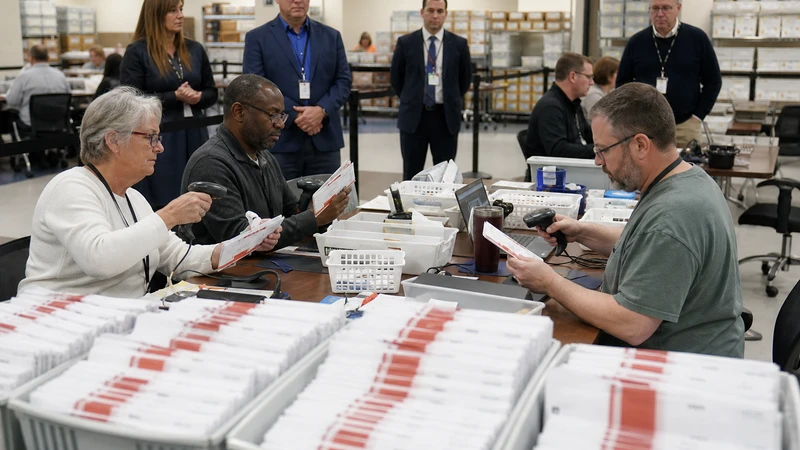
In ordinary election administration, chain of custody refers to documented control over ballots and voting materials. For mailed ballots, that can include logs showing when ballots are sent, systems for tracking returned envelopes, secure storage, bipartisan handling rules, surveillance or tamper-evident seals for drop boxes, and written procedures for transporting ballots from collection points to election offices.
There is no single national standard that governs all of this in detail. The Constitution gives states broad authority to run elections, subject to federal protections. Congress has set important requirements in areas such as voting rights, military and overseas voting, and voting system standards, but the day-to-day rules for absentee and mail ballots vary widely by state.
That variation is one reason the debate has become so heated. A voter in one state may receive a ballot automatically before major elections. A voter in another may need to request one and provide an approved reason. Some states rely heavily on signature verification. Others require witness signatures, identification numbers, notarization in limited cases, or other forms of voter authentication. Deadlines also differ, including whether a ballot must be received by Election Day or merely postmarked by then.
None of these policy choices is inherently sinister. But all of them require clarity. Ambiguity is the friend of suspicion.
The Conservative Case for Tight Procedures
Conservatives should resist two temptations in this argument. The first is to treat mail voting itself as illegitimate. That is too broad a claim. Absentee voting has long served soldiers, seniors, disabled voters, rural residents, students, and citizens whose work or family obligations make in-person voting difficult. A serious governing party should not speak as if those voters are an afterthought.
The second temptation is to wave away concerns about custody and verification as mere paranoia. That is also a mistake. Elections depend not only on accurate outcomes but on procedures visible enough to command consent from the losing side. A republic cannot run on the assumption that citizens should simply trust officials because officials say they are trustworthy.
The conservative position, properly understood, is not hostility to voting. It is devotion to ordered liberty. That means broad lawful participation joined to procedures that are durable, observable and hard to manipulate. Voting is a right, but an election is also a public act. The public has a legitimate interest in knowing that the act was conducted under disciplined rules.
Where States Are Focusing
Across the country, the most practical debates tend to cluster around a few issues.
- Ballot tracking: Many jurisdictions use barcodes or online systems allowing voters to see when a ballot was mailed, received and accepted. Tracking does not solve every problem, but it gives both voters and officials a clearer record.
- Drop boxes: Secure drop boxes can reduce dependence on postal delivery, but they raise custody questions. States and counties must decide where boxes are placed, whether they are monitored, how often ballots are collected, and who may retrieve them.
- Signature verification: Matching signatures can help authenticate mailed ballots, but it also requires training and consistent standards. Voters whose ballots are flagged often need a fair chance to fix, or “cure,” the problem before a deadline.
- Ballot harvesting rules: States differ on whether third parties may collect and return ballots. A narrow allowance for family members or caregivers is one thing; large-scale political collection programs raise more complicated questions about pressure, privacy and accountability.
- Observation and transparency: Parties, candidates and the public need access sufficient to verify the process without disrupting it. The answer is not chaos in counting rooms, but neither is a closed-door system that treats observers as intruders.
Access and Integrity Are Not Enemies
One of the exhausting features of modern election debates is the way each side is asked to choose a single moral concern. If you care about access, you are assumed to be indifferent to fraud. If you care about integrity, you are accused of wanting fewer people to vote.
This is a false choice. A well-run mail voting system can make voting easier for lawful voters while making misconduct harder. Indeed, sloppy administration is often the enemy of access as much as integrity. If voters do not know deadlines, if cure procedures are confusing, if signature rules are unevenly applied, ballots may be rejected for reasons that have little to do with fraud and much to do with bureaucratic weakness.
The goal should be a system simple enough for ordinary citizens to use and strict enough for losing candidates to accept. That requires boring virtues: written procedures, trained workers, documented transfers, secure storage, prompt public reporting, and consistent enforcement.
Federalism Needs Standards, Not Theatrics
Because elections are state-run, reform will not look the same everywhere. A rural county with a small electorate faces different logistical problems from a large metropolitan county processing hundreds of thousands of envelopes. States that vote largely by mail have years of administrative experience that newer adopters may lack.
Still, federalism is not an excuse for improvisation. State legislatures should set clear statutes rather than leaving major choices to last-minute litigation or emergency administrative guidance. Election officials should publish procedures in advance. Courts should be cautious about changing rules close to an election, a practice that almost always feeds doubts afterward, no matter which party benefits.
The best reforms are likely to be unglamorous: uniform statewide custody logs, mandatory two-person ballot transfer teams where feasible, public drop-box collection schedules, clear voter identification requirements for mail ballot requests, transparent signature verification standards, and auditable records from receipt through tabulation.
The Point Is Consent
In a healthier country, election administration would not carry so much symbolic weight. We would argue about taxes, immigration, schools and foreign policy, then accept defeat without treating every lost race as proof of corruption. But we do not live in that country at the moment. Trust is thin, and thin trust places a heavier burden on institutions.
That burden cannot be met by rhetoric alone. It must be met by process.
Mail-in voting can be part of a secure election system. But it asks citizens to trust a longer and less visible path between voter and count. The answer is not to pretend that this path raises no questions. The answer is to mark the path carefully, document each handoff, invite lawful scrutiny, and punish misconduct when it occurs.
A ballot is a small thing: paper, envelope, signature, barcode. Yet in that small thing rests the peaceful transfer of power. It deserves rules as serious as the trust we place in it.