
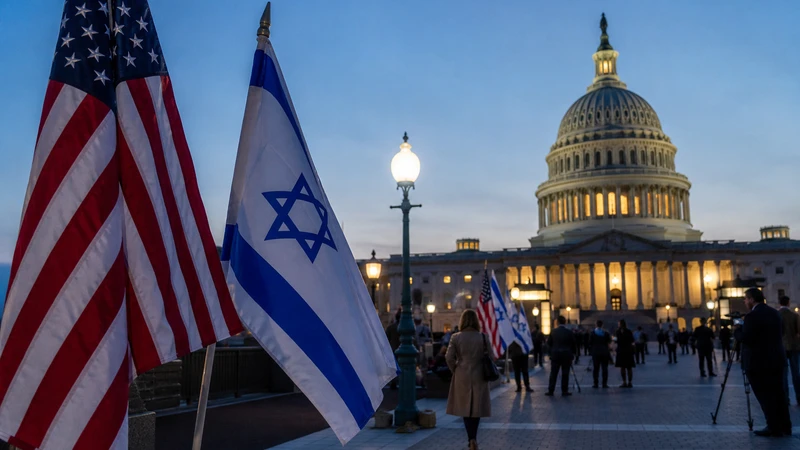
Israel Aid Debate Tests an Old Washington Consensus
For decades, American aid to Israel occupied a relatively stable place in Washington politics. Democrats and Republicans argued over many things, but support for Israel was usually treated as a strategic commitment, a moral obligation, and a domestic political fact all at once. That consensus has not disappeared. But it is being tested in ways that would have been hard to imagine a generation ago.
The immediate issue is U.S. foreign aid to Israel: how much, under what conditions, and with what degree of oversight. The larger issue is whether the United States still knows how to sustain alliances in an age when both parties contain growing factions skeptical of foreign commitments.
Israel remains the largest cumulative recipient of U.S. foreign assistance since World War II, according to the Congressional Research Service. Under a 2016 memorandum of understanding, the United States committed to provide $38 billion in military aid over 10 years, from fiscal years 2019 through 2028. That works out to $3.8 billion annually, including support for missile defense programs such as Iron Dome, David's Sling, and Arrow.
After the Hamas attacks of Oct. 7, 2023, Congress also approved emergency security assistance for Israel as part of a broader foreign aid package signed in April 2024. That legislation included funding connected to Israel's defense and humanitarian needs in the region, alongside major aid for Ukraine and Taiwan-related security priorities.
But the Gaza war changed the political environment. Supporters of aid point to Hamas, Hezbollah, the Houthis, and Iran as evidence that Israel faces a regional security threat that is also tied to American interests. Critics point to civilian suffering in Gaza and ask whether U.S. weapons and funding give Washington too little leverage over Israeli conduct.
Three Camps Are Emerging
The debate is not simply left versus right. In Congress, three broad camps have emerged.
The first camp is the traditional pro-Israel coalition. It includes most Republicans and many Democrats who view aid to Israel as a central element of American security policy in the Middle East. They argue that Israel is a democratic ally in a hostile region, that its military edge deters wider war, and that U.S. support signals reliability to allies far beyond the Middle East.
The second camp wants aid conditioned more directly on humanitarian and legal standards. This group is most visible among progressive Democrats, though its concerns are not limited to the left. Its members argue that American assistance should be tied to clearer requirements on civilian protection, humanitarian access, and compliance with U.S. arms transfer law. They often cite existing laws, including the Arms Export Control Act and the Foreign Assistance Act, as tools that should be enforced more aggressively.
The third camp comes from the right and is motivated less by Gaza than by a broader skepticism of foreign aid. Some America First conservatives see aid to Israel, Ukraine, and other allies as part of the same Washington habit: writing checks abroad while the border, debt, and industrial base at home remain under strain. Many in this camp remain culturally sympathetic to Israel but are increasingly hostile to open-ended commitments.
That last point matters. The future of Israel aid may be shaped as much by Republican arguments about spending and restraint as by Democratic arguments about human rights.
The Policy Questions Behind the Politics
At the policy level, the argument turns on several practical questions.
First, should U.S. military aid to Israel remain largely predictable under the current 10-year framework, or should Congress revisit the size and terms of the package before the current memorandum expires in 2028? Supporters of predictability argue that long-term planning is essential for missile defense and regional deterrence. Critics argue that automatic aid reduces American leverage.
Second, what counts as legitimate oversight? The United States already has laws governing arms transfers and foreign assistance. The question is whether Congress and the executive branch are applying those rules with sufficient seriousness. Oversight need not mean abandonment. In fact, conservatives should be the first to insist that public money comes with accountability. A blank check is not a strategy; it is a substitute for one.
Third, how should Washington balance Israel's right of self-defense against the humanitarian catastrophe that prolonged urban war creates? This is not a sentimental question. Civilian suffering can become a strategic liability, strengthening terrorist recruitment, weakening Arab partners, and making it harder for the United States to maintain diplomatic coalitions. Morality and strategy are not always enemies. Sometimes they are warning lights on the same dashboard.
A Conservative Case for Support and Discipline
An institutional conservative view should begin with realism. Israel lives in a dangerous neighborhood. Hamas did not attack Israel because of a line item in an appropriations bill. Iran's network of proxy forces is not a fiction invented by lobbyists. A weakened Israel would not produce peace by magic. It would invite testing from enemies who understand power in the oldest and least sentimental way.
At the same time, support for an ally is not the same thing as surrendering judgment to that ally. The United States has its own interests, its own laws, and its own moral responsibilities. A mature alliance is not a parent-child relationship, in either direction. It is a partnership between nations whose interests overlap greatly but not perfectly.
This is where Washington often fails. Our debates tend to become theatrical. One side speaks as if any condition on aid is betrayal. The other speaks as if Israel's security predicament can be solved by stern statements from committee rooms. Neither posture is adequate to the world as it is.
The better approach would preserve Israel's qualitative military edge, continue support for defensive systems that protect civilians from rockets and missiles, and maintain the credibility of American commitments. But it would also require regular reporting to Congress, serious review of weapons use where civilian harm is alleged, and a clearer connection between emergency assistance and defined strategic objectives.
That is not anti-Israel. It is pro-governance. Conservatives, of all people, should not be embarrassed to say that alliances require prudence, budgets require scrutiny, and war requires moral limits.
Why This Debate Will Not Go Away
The Israel aid argument is likely to remain central because it sits at the crossing point of several larger American debates: the future of U.S. global leadership, the rise of populist restraint, the moral cost of modern war, and the political power of younger voters who do not remember the older bipartisan consensus.
There is also a religious undercurrent that should not be ignored. For many Americans, especially evangelical Christians and traditional Jews, support for Israel is not only strategic but civilizational and even theological. For others, especially younger secular voters and some Christians on the left, the plight of Palestinian civilians has become a moral test of American policy. A wise politics would not sneer at either instinct. It would try to discipline both with facts, law, and prudence.
The temptation in Washington is always to reduce hard questions to team colors. But foreign aid is not a sacrament, and it is not a sin. It is a tool. Like any tool, it can serve wise purposes or foolish ones depending on how it is used.
The United States should stand by Israel against terrorism and Iranian aggression. It should also remember that standing by an ally does not require closing our eyes. The harder task is to do both at once: to be loyal without being careless, and critical without being faithless. That is the kind of statesmanship the moment requires, and the kind Washington too rarely supplies.