Congregations Step Back Into Civic Life
As the country moves toward another consequential election, one of the oldest engines of American civic participation is again becoming visible: the local congregation.
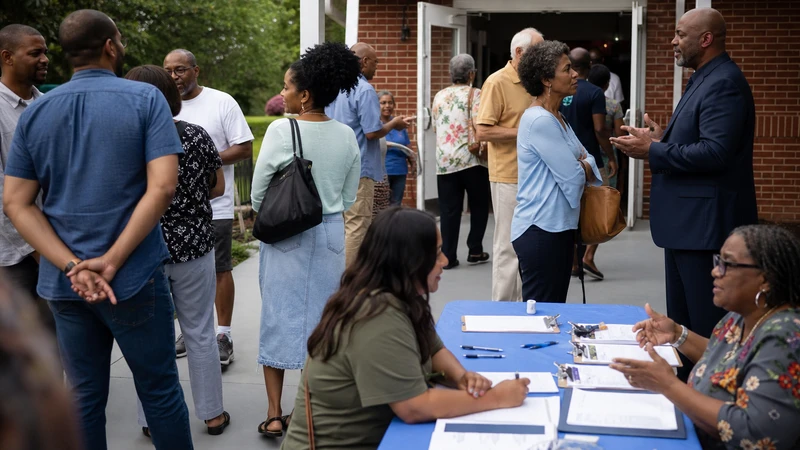
Across denominations and religious traditions, churches, synagogues, mosques, and faith-based nonprofits are organizing voter registration tables, hosting candidate forums, reminding members about registration deadlines, and arranging transportation for elderly or disabled voters. Some of these efforts are modest, consisting of little more than a folding table in a fellowship hall after services. Others are more organized, involving coalitions that span neighborhoods, racial groups, and theological traditions.
The work is not new. Religious communities have long helped Americans understand voting as more than a private preference. In the civil rights era, Black churches served as organizing centers for voter education and turnout. Catholic parishes have often distributed issue guides rooted in church teaching. Evangelical churches became major hubs of conservative political mobilization in the late 20th century. Jewish and mainline Protestant groups have also been active in voter access and public affairs.
What is notable now is not that faith groups are involved, but that their involvement is being tested by a political culture that wants every institution to pick a team.
The Legal Line: Participation, Not Partisanship
For houses of worship that are organized as tax-exempt nonprofits, the basic federal rule is clear. Under Internal Revenue Service guidance, 501(c)(3) organizations may conduct nonpartisan voter education, voter registration, and get-out-the-vote activity. They may not endorse or oppose candidates for public office, and they may not use tax-exempt resources to aid a campaign.
That distinction matters. A church may encourage its members to vote. It may explain how to register. It may host a candidate forum if the event is structured fairly and does not favor one candidate. It may speak on moral and policy questions, including abortion, poverty, religious liberty, crime, education, immigration, and war. But once the minister, rabbi, imam, or lay leader turns the pulpit into a campaign podium, the institution crosses a line that is both legal and spiritual.
There are, of course, ongoing debates about whether the federal restrictions on candidate endorsements burden free speech. Many conservatives have criticized the so-called Johnson Amendment, arguing that it chills religious leaders from speaking plainly about public affairs. That concern should not be dismissed. A government powerful enough to police sermons is a government that deserves suspicion.
But there is a second danger, one religious conservatives should be especially able to see. Politics does not merely threaten religion from the outside. It can also hollow it from within. A congregation that becomes a party precinct may gain influence for a season while losing the very authority that made its voice worth hearing.
Why Faith Still Moves Voters
Faith communities remain effective civic institutions for a simple reason: they are built around trust. People may ignore a mailer, delete a campaign text, or tune out a television ad. They are less likely to ignore a neighbor from the pew, a pastor they know, or a ministry leader who has visited them in the hospital.
This is especially true among Americans who feel distant from government. A local congregation can translate civic life into human terms. It can explain where to vote, how early voting works, what identification may be required under state law, and how to request an absentee ballot. It can do this without pretending that voting is the whole of citizenship.
That last point is important. The healthiest religious political engagement does not reduce citizenship to Election Day. It teaches that voting is one duty among many: raising children well, serving the poor, obeying just laws, challenging unjust ones, keeping promises, and telling the truth. A nation needs voters. But it needs formed souls even more.
Here the conservative insight remains useful. America is not held together only by statutes and agencies. It depends on institutions that government did not create: families, congregations, schools, charities, voluntary associations, and local habits of responsibility. When those institutions weaken, politics becomes louder because it is asked to do work it cannot do.
A Role for Moral Formation, Not Machine Politics
The strongest case for faith-based civic engagement is not that religious voters can deliver victories for one coalition or another. It is that religious communities can remind citizens that public life has moral stakes.
That does not mean every policy dispute has an obvious religious answer. Christians who share a creed may still disagree about tax rates, health care design, border enforcement, policing strategies, or foreign policy. Jewish communities contain deep internal disagreement. Muslim voters are not a monolith. The idea that faith produces automatic political uniformity is one of the great lazy assumptions of modern punditry.
But faith can clarify the questions. It can ask whether the unborn child, the prisoner, the addict, the migrant, the elderly patient, and the struggling family are being treated as problems to be managed or persons to be honored. It can ask whether freedom is being confused with appetite, and whether compassion has been detached from order. It can ask whether a policy strengthens the family, respects conscience, and protects the weak.
These are not merely partisan questions. They are human questions. And if religious communities stop asking them, they will not be replaced by neutrality. They will be replaced by slogans.
The Risk of Sacred Language in a Tribal Age
The obvious risk is that faith-based turnout work becomes another form of tribal sorting. On the right, religious appeals can become a way of baptizing anger or treating America as a possession to be reclaimed rather than a nation to be served. On the left, religious language can be used to bless progressive activism while quietly discarding doctrines that stand in the way.
Both temptations are real. Both are spiritually cheap. The test is whether a congregation’s political activity leaves room for repentance. If every sermon confirms the instincts of one party and condemns only the sins of its opponents, something has gone wrong. The God of Scripture is not a precinct captain.
For conservative readers, the lesson should be double. We should defend the right of religious communities to participate openly in civic life, speak from their traditions, and encourage voting. But we should also resist the urge to measure religious seriousness by partisan usefulness. The church is not more faithful when it is more politically convenient.
What Responsible Engagement Looks Like
In practical terms, responsible faith-based civic engagement is not mysterious. It includes nonpartisan registration drives, careful voter education, civil candidate forums, rides to polling places offered without regard to party, and sermons that address moral principles without pretending that prudence has been abolished.
It also requires humility from public officials. Candidates should be welcome to visit religious communities, listen to their concerns, and answer questions. They should not expect clergy to function as campaign staff. Nor should government officials treat religious voters as a problem to be managed unless they remain safely private.
A free society needs citizens who can bring their deepest convictions into public life without demanding that the state enforce every article of faith. That balance is difficult, but it is one of the achievements of the American experiment.
Faith communities can help increase voter turnout. More importantly, they can help remind Americans why voting matters. In a season when politics often feels like a contest of appetites and resentments, that may be the more necessary service. The polling place is not a sanctuary. But citizens who have been formed in sanctuaries may enter it with a stronger sense of duty, restraint, and hope.