
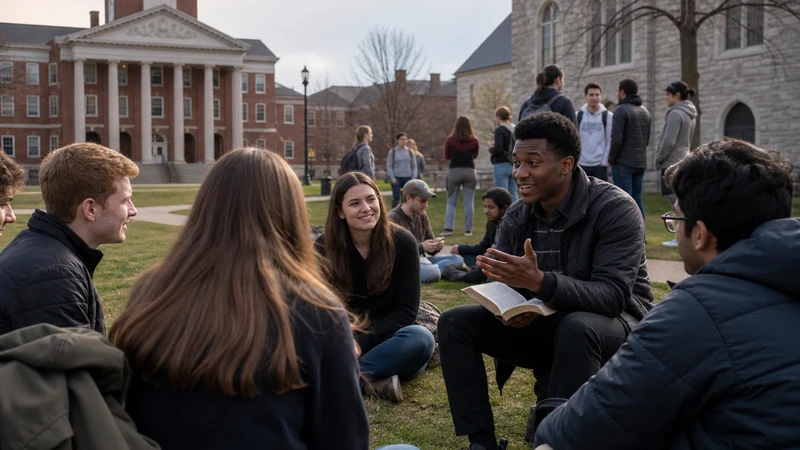
Religious Speech on Campus Is a Test of Institutional Neutrality
Every fall, American colleges relearn an old lesson: speech is easy to praise in the abstract and difficult to protect in practice. The hardest cases are rarely the popular ones. They involve a student group with unpopular convictions, a speaker some classmates find offensive, or a religious organization that wants the same access to rooms, bulletin boards, and student activity funds as everyone else.
That is where the debate over religious expression on college campuses now sits. It is not mainly a debate about whether universities should become religious institutions. They should not, at least not if they are public universities bound by the First Amendment or private universities that promise broad freedom of inquiry. The question is narrower and more important: Can religious students participate in campus life as religious students, or must they translate their beliefs into safer, thinner language before entering the public square?
For conservatives, and for anyone who cares about the health of a liberal education, the answer should be clear. A university that welcomes every theory of identity, politics, sexuality, economics, and justice, but treats orthodox religious belief as uniquely suspect, is not being neutral. It is merely enforcing a different orthodoxy.
The Legal Ground Is Not New
The basic legal principles are well established. Public colleges and universities are government actors. They may set reasonable time, place, and manner rules for events. They may prevent harassment, threats, and substantial disruption. But they may not discriminate against speech because it is religious.
The Supreme Court has said as much in a line of cases stretching back decades. In Widmar v. Vincent in 1981, the Court held that a public university that opened its facilities to student groups could not exclude a religious group from meeting there because of the religious content of its speech. In Rosenberger v. University of Virginia in 1995, the Court ruled that a public university could not deny student activity funding to a Christian publication while funding other student publications on secular topics. The principle was not that the state had to sponsor religious doctrine. It was that once a forum was opened, religious viewpoints could not be treated as second-class speech.
There are limits. In Christian Legal Society v. Martinez in 2010, the Court upheld a public law school policy requiring recognized student organizations to accept all students as members and leaders, provided the policy was applied evenly to all groups. That case remains important because it shows the tension universities must manage: free association on one side, anti-discrimination rules on the other. But even there, the key word was evenhandedness. Universities cannot write one rule for religious conservatives and another for everyone else.
This legal history matters because many campus controversies begin not with grand constitutional theory but with small administrative decisions. A religious club is denied recognition. A prayer gathering is told it must move while other ideological gatherings remain. A student government questions whether a faith-based group may require its leaders to affirm the beliefs the group exists to advance. These disputes may look minor to outsiders. To students, they decide whether faith is allowed to be a real part of campus citizenship.
Equal Access Is Not Establishment
The most common objection is that permitting religious speech in public campus spaces amounts to government endorsement of religion. This concern is understandable, especially in a country with a constitutional ban on establishing religion. But it confuses access with approval.
If a university lets a Democratic club, a Republican club, an environmental group, a Muslim student association, a Catholic fellowship, and a secular humanist group reserve the same classroom after hours, it is not endorsing all of their claims. It is recognizing that a campus is a forum for argument and association. The state does not become Catholic because a Catholic group meets in a lecture hall, any more than it becomes Marxist because a socialist club distributes pamphlets outside the student union.
This distinction is essential to pluralism. A public institution can remain secular in governance while allowing religious citizens to speak and organize in religious terms. Indeed, that arrangement is one of the quiet achievements of the American system. We do not need a confessional state to protect religion. We need a limited state that knows what it is not competent to decide.
The Policy Problem: Vague Rules and Uneven Enforcement
The practical challenge for colleges is that many speech policies are written broadly enough to be used selectively. Rules against harassment, exclusion, disruption, or discrimination can serve legitimate purposes. No serious person wants students threatened or intimidated. But vague standards can also become tools for suppressing views that offend the campus majority.
Religious speech is especially vulnerable because it often makes moral claims. Traditional Christian, Jewish, Muslim, and other religious teachings can clash with modern campus assumptions about sex, gender, and identity. A university does not have to agree with those teachings. But if it treats the mere expression of them as harmful, it has effectively declared that only privatized religion is acceptable.
That is not religious liberty. It is a polite form of exile.
There are concrete steps institutions can take. Public universities should adopt clear viewpoint-neutral policies for facility use, student organization recognition, and student activity funding. If leadership requirements are allowed for ideological groups, they should be allowed for religious groups as well. A college atheist group is not expected to elect a devout Baptist as its president; a Catholic group should not be forced to choose leaders who reject Catholic teaching. The principle is not privilege. It is coherence.
Student conduct rules should also distinguish between expression and targeted misconduct. A student quoting Scripture in a debate, handing out religious literature, or inviting classmates to prayer is engaging in protected expression. A student threatening, stalking, or persistently harassing an individual is doing something else. Collapsing these categories helps no one. It weakens genuine anti-harassment enforcement while chilling legitimate speech.
Private Colleges Have Obligations Too
Private universities are not bound by the First Amendment in the same way public universities are, unless state law or specific commitments create similar obligations. But many private institutions advertise themselves as places of open inquiry. They recruit students with promises of debate, diversity, and intellectual freedom. Those promises should count.
A private college may have a religious identity, a secular progressive identity, or some other mission. Honesty requires that it say so plainly. What it should not do is sell itself as a marketplace of ideas and then punish students for bringing unfashionable religious ideas into that marketplace.
Conservatives should resist the temptation to answer progressive campus censorship with censorship of their own. The goal is not to make universities safe for religion by making them unsafe for everyone else. The goal is to restore the older liberal bargain: strong protections for speech, strong protections for conscience, and confidence that truth does not need bureaucratic protection from argument.
A Campus Worthy of Its Name
The deeper issue is cultural, not merely legal. Many students arrive at college having been trained to see disagreement as injury. Many administrators, fearing controversy, prefer quiet management to open debate. But a university that fears argument has forgotten its vocation.
Religious students do not need special treatment. They need the ordinary rights that a free society owes to everyone: the right to speak, gather, persuade, dissent, and live with integrity. If their claims are weak, let them be answered. If they are strong, let them be heard. But do not exclude them in the name of inclusion.
A campus that cannot make room for prayer, Scripture, theology, and moral conviction is not becoming more enlightened. It is becoming smaller. And the strange thing about the life of the mind is that it cannot breathe in small rooms for very long.