
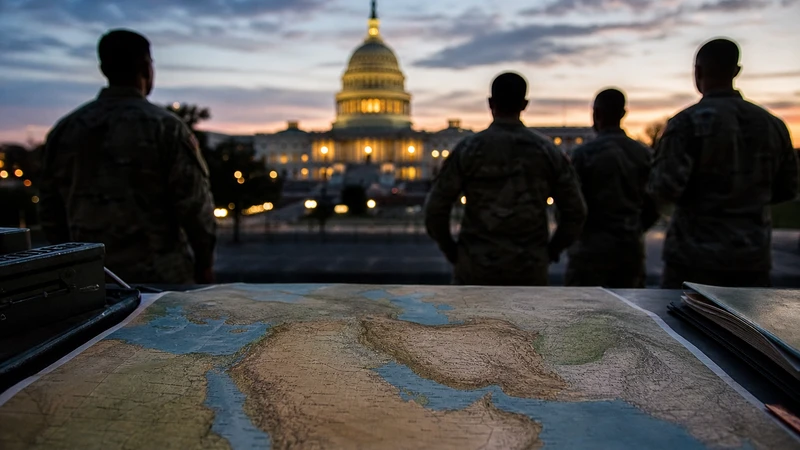
Iran Operations Test Congress’s War Powers
There is a way wars begin in the American system that everyone understands from civics class: Congress debates, Congress authorizes, and the president commands. Then there is the way wars more often begin in modern Washington: an emergency, a strike, a retaliation, a briefing, a classified justification, and only later a public argument over what exactly the country has entered.
The possibility of continued American and Israeli military operations against Iran belongs squarely in that second category. Israel has long treated Iran’s nuclear program, missile forces, and support for armed groups as strategic threats. The United States has its own interests: protecting American forces, preserving freedom of navigation, supporting Israel’s security, and preventing Iran from acquiring a nuclear weapon. None of those interests is imaginary. But neither are they a substitute for constitutional clarity.
If military operations remain limited, temporary, and defensive, presidents of both parties have claimed broad Article II authority to act. If they become sustained, offensive, and designed to degrade Iran’s military or nuclear infrastructure over time, the question changes. At that point, Congress cannot be treated as a spectator with better parking.
The Constitutional Question Washington Keeps Avoiding
The Constitution gives Congress the power to declare war, raise and fund the armed forces, and regulate their use. It names the president commander in chief. That division was not an accident. The founders wanted energy in defense, but they feared executive war-making. They knew, as human beings generally know when they are honest, that power tends to justify itself by calling delay dangerous.
The 1973 War Powers Resolution was Congress’s effort, after Vietnam, to claw back some authority. It requires the president to notify Congress within 48 hours of introducing U.S. forces into hostilities or situations where hostilities are imminent. It also says forces must be withdrawn after 60 days unless Congress authorizes the action, with a possible 30-day extension. Presidents have often treated the law as constitutionally questionable while still reporting under it, a Washington compromise that has the charm of a locked door with a decorative key.
Iran presents a particularly difficult case because there is no standing congressional authorization aimed at a broad war with Tehran. The 2001 Authorization for Use of Military Force was directed at those responsible for the Sept. 11 attacks and associated forces. The 2002 Iraq authorization was about Saddam Hussein’s regime and Iraq. Neither was written as a blank check for war against Iran, even if Iranian-backed militias have repeatedly threatened American personnel in the region.
That distinction matters. A strike against a militia firing on U.S. troops is one thing. A continuing campaign against Iranian territory, command networks, nuclear facilities, or missile sites is another. The first can plausibly be defended as force protection. The second begins to look like war in all but name.
Regional Security: Deterrence and Escalation
The case for military pressure is not frivolous. Iran has built influence through armed partners and proxies, including Hezbollah in Lebanon, militias in Iraq and Syria, the Houthis in Yemen, and Palestinian militant groups. Its missile and drone capabilities have become central to regional instability. Israel, which lives within range of many of these threats, has fewer illusions than many Western capitals about the nature of the regime in Tehran.
A conservative foreign policy should understand deterrence. Weakness can invite aggression. If Iran concludes that attacks through proxies carry no meaningful cost, the result may be more attacks, not fewer. There are moments when force prevents a larger war by reminding an adversary that limits exist.
But deterrence is not the same thing as drift. The Middle East is full of tripwires: U.S. bases in Iraq and Syria, shipping lanes near the Strait of Hormuz, Gulf energy infrastructure, Israeli cities, Lebanese politics, and fragile governments that can be pulled into a wider fight. A campaign meant to restore deterrence can, if badly bounded, produce the very regional war it was meant to prevent.
This is especially true if Iran responds indirectly. Tehran has often preferred pressure that gives it deniability: rockets from militias, drone attacks, maritime harassment, cyber activity, or pressure through allied groups. That pattern complicates the American response. A president may feel compelled to answer each attack; Congress may wake up weeks later to discover that a chain of retaliations has become a regional military commitment.
Diplomacy Does Not Mean Naivete
Military action also reshapes diplomacy. Iran’s nuclear program has been the subject of international negotiation for years, most notably through the 2015 nuclear agreement, which the United States left in 2018. Since then, the International Atomic Energy Agency has reported serious concerns about Iran’s nuclear advances, including uranium enrichment at levels far above what the 2015 deal allowed. Enrichment at 60 percent is not the same as a bomb, but it is much closer to weapons-grade material than civilian nuclear power requires.
For Israel and the United States, that reality creates a grim strategic calendar. Diplomacy can buy time, restrain enrichment, and provide inspections. But diplomacy without leverage becomes a sermon delivered to a locked room. The hard question is how to use pressure in a way that strengthens negotiation rather than making negotiation impossible.
There is no magic formula. Strikes may delay a nuclear program while hardening Iran’s leadership against compromise. Sanctions may weaken the regime while strengthening its propaganda. Negotiations may restrain escalation while giving Tehran time to maneuver. The task of statecraft is not to choose between purity and surrender. It is to manage imperfect tools in a fallen world.
What Congress Should Demand
Congress should not wait for a crisis to become a fait accompli. Lawmakers should demand clear answers from the administration, preferably in public wherever possible and in classified sessions where necessary.
- What is the mission? Is the United States defending forces, supporting Israeli operations, degrading Iranian capabilities, or seeking broader regime coercion?
- What is the legal authority? Is the administration relying on Article II alone, an existing authorization, or a new request from Congress?
- What are the limits? Which targets are included, which are excluded, and what would trigger expansion?
- What is the diplomatic objective? Is the goal a renewed nuclear framework, regional de-escalation, deterrence, or something more ambitious?
- What is the exit strategy? Not every conflict has a neat ending, but every serious policy needs a theory of how pressure produces a better outcome.
This is not isolationism. It is constitutional conservatism. A country that sends pilots, sailors, intelligence officers, and troops into danger owes them more than improvisation wrapped in patriotic language. It owes them a lawful mission and a politically accountable strategy.
Support for Israel’s security should remain a serious American commitment. So should preventing a nuclear-armed Iran. But seriousness is not measured by how quickly one dismisses procedure. In a republic, procedure is part of morality. It is how a free people decide when the terrible burden of war is necessary.
The deeper danger is not only that America might do too much or too little. It is that America might do something consequential without ever quite deciding to do it. That is how republics lose the habit of self-government: not usually through one dramatic betrayal, but through a series of emergencies in which the permanent things are postponed until after the briefing.
Congress should not micromanage battlefield decisions. But it should reclaim its rightful role in deciding the scope of conflict. If operations against Iran are limited, the administration should explain their limits. If they are becoming a sustained campaign, it should seek authorization. And if lawmakers believe the mission is necessary, they should have the courage to vote for it rather than applaud from the cloakroom.
War powers debates can sound abstract until the missiles fly. Then they become the difference between a republic acting deliberately and an empire acting by reflex. Conservatives, of all people, should prefer the republic.