
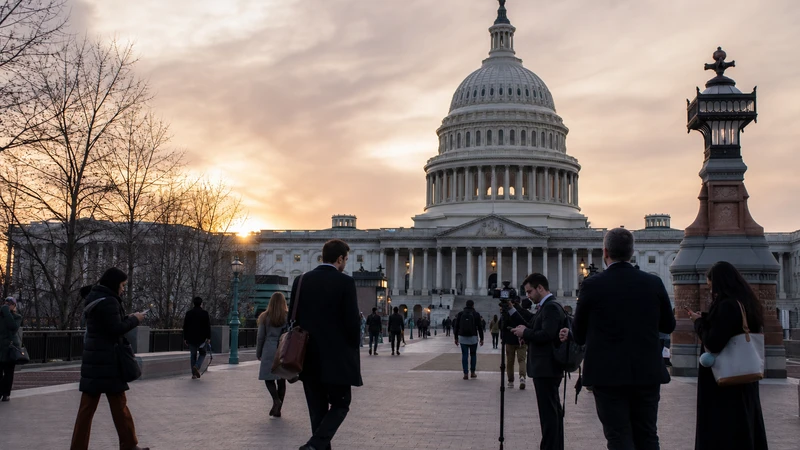
Congress Enters the Narrow Season of Governing
There is a peculiar rhythm to a lame-duck Congress. The election is over, the voters have spoken, and yet the old Congress remains in place for a few final weeks, still holding the power to spend, confirm, bargain and bind. It is a constitutional arrangement, not a scandal. But it always carries a faint sense of borrowed time.
This year-end session is expected to revolve around four familiar priorities: spending legislation to keep the government funded, a defense policy bill, possible energy and permitting reforms, and Senate action on judicial nominations. Each item has its own political logic. Together they pose a larger question: should a departing Congress use its remaining days for necessary maintenance, or for major policy choices that the next Congress may wish to revisit?
That question is not merely procedural. In Washington, process is often where principle hides.
Spending Comes First, Because Deadlines Do
The most urgent business is likely to be government funding. Congress has grown accustomed to relying on short-term continuing resolutions when it cannot complete the regular appropriations process on time. These measures keep agencies operating, but they also freeze priorities in place and push hard choices into the future.
From a conservative perspective, that habit is one of the quiet failures of modern governance. A continuing resolution can be prudent when it prevents an unnecessary shutdown. But a government that funds itself by emergency extension after emergency extension is not really budgeting. It is drifting with paperwork.
The alternative, often floated in late-year negotiations, is a large omnibus spending bill. The advantage is obvious: it provides stability and gives agencies clearer direction. The problem is just as obvious: massive spending packages are frequently negotiated by leadership, released late, and passed under deadline pressure. Members are asked to vote on hundreds or thousands of pages with limited time for scrutiny.
The responsible course would be narrow and transparent. If Congress cannot finish appropriations properly, it should avoid using the lame-duck period to load a funding bill with unrelated policy demands. The country needs a functioning government. It does not need a Christmas tree bill decorated with every ornament lobbyists can find.
Defense Policy Usually Finds a Path
The annual defense authorization bill is another likely focus. The National Defense Authorization Act has passed annually for decades, making it one of the few remaining examples of durable congressional routine. In an era of polarization, the NDAA survives because members in both parties still recognize that national defense cannot simply be treated as another venue for theatrical conflict.
That does not mean the defense bill is apolitical. It often becomes the vehicle for fights over military personnel policy, procurement, foreign assistance, China, Ukraine, the industrial base and the balance between readiness and social policy inside the armed forces.
Here, too, conservatives should distinguish between seriousness and symbolism. A defense bill should strengthen deterrence, improve readiness, support service members and make procurement more accountable. It should not become a catchall for every cultural fight in miniature. Some battles are necessary. But not every battle belongs inside the defense budget.
The United States faces a more dangerous world than the one it imagined after the Cold War: a revisionist Russia, an assertive China, instability in the Middle East, and continuing pressure on the defense industrial base. A lame-duck Congress can do real good if it focuses on capacity, accountability and deterrence rather than performative amendments designed mainly for fundraising emails.
Energy Reform May Be the Hardest Bargain
Energy permitting reform remains the most tempting and difficult area for bipartisan dealmaking. Republicans generally want faster approval for pipelines, drilling, export infrastructure and mining projects. Many Democrats increasingly recognize that clean-energy projects also need permitting relief, especially for transmission lines and large-scale infrastructure.
That shared frustration creates an opening. America cannot build an abundant energy future if every major project must pass through a maze that rewards delay. A country serious about energy security, manufacturing, lower costs and environmental stewardship should want a permitting system that is rigorous but not endless.
The conservative case for reform is straightforward. Energy abundance is not just an industry priority; it is a household priority, a national security priority and a civilizational priority. Modern life runs on reliable power. The poor suffer first when energy becomes scarce or expensive. Nations that cannot build infrastructure eventually become nations that cannot govern themselves.
Still, lame-duck energy legislation requires caution. A permitting deal written in haste could either accomplish too little or trade away too much. Lawmakers should focus on clear timelines, limits on duplicative review, judicial reforms that discourage endless litigation, and a fair path for projects that serve national interests. If such a package is not ready, Congress should not pretend that a rushed compromise is a breakthrough.
Judges and the Senate’s Final Leverage
The Senate’s unique lame-duck question is judicial confirmations. Presidents often push to confirm as many nominees as possible before the Senate changes composition or the legislative calendar expires. The Constitution gives the Senate advice-and-consent authority, and there is nothing improper about using the full term to confirm qualified nominees.
But the judiciary is different from ordinary policymaking. Federal judges receive life tenure. A spending bill may expire; a judge may serve for decades. That gives late-term confirmations a special weight.
Both parties have used election-year and lame-duck periods to advance nominees when they had the votes. Both parties have complained when the other side did the same. The pattern is familiar enough that expressions of shock should be discounted. What matters is not whether confirmations are politically useful. Of course they are. What matters is whether the nominees are competent, ethical and within the broad mainstream of constitutional interpretation.
For conservatives, the lesson of recent decades is that courts matter because law matters. But that conviction should not require pretending that every nominee is an emergency or every vacancy a battlefield at Gettysburg. A Senate that treats the judiciary as merely another partisan prize will eventually weaken public confidence in the courts it claims to defend.
The Proper Work of a Lame Duck
The best argument for a productive lame-duck session is that the country still needs governing after Election Day. The best argument against an ambitious one is that voters have just rendered a judgment, and departing lawmakers should be careful about making large commitments on their way out.
Those two truths are not enemies. They are the boundaries of prudence.
Congress should fund the government without disguising excess as necessity. It should pass a serious defense bill that strengthens the armed forces. It should pursue energy reform if a real and durable agreement exists. And the Senate should handle judicial nominations with constitutional seriousness rather than panic or triumphalism.
The deeper problem is that Washington has trained itself to govern at the last possible moment. Deadlines become leverage. Crisis becomes routine. Members complain about broken process and then depend on it. The result is not merely inefficiency; it is a slow erosion of trust.
A lame-duck Congress cannot repair that damage by itself. But it can either worsen the pattern or modestly resist it. There is honor, sometimes, in doing only what must be done and doing it plainly. In politics, as in life, the final weeks often reveal what a person or an institution valued all along.